
| Currently viewing: Corporate governance highlights / Next: Our people and their remuneration |
 |
 |
 |
Downloads |  |
Home |
Corporate governance highlights
The MTN board believes that strong corporate governance is essential for the achievement of sustainable value for all stakeholders. Accordingly, the Group is committed to entrenching the highest levels of corporate governance and continues to make significant progress in implementing structures, policies and procedures all aimed at strengthening governance within the organisation. MTN aims to provide stakeholders with an accurate and transparent governance report which provides details of governance enhancements and achievements during the year under review. |

Audit committee: AF van Biljon (chairman), NP Mageza, MJN Njeke, JHN Strydom (withdrawn 29 May 2012), J van Rooyen
Risk management, compliance and corporate governance committee: J van Rooyen (chairman), KP Kalyan, NP Mageza, MLD Marole, MJN Njeke, JHN Strydom
Nominations committee: MC Ramaphosa (chairman), A Harper, AT Mikati, JHN Strydom (nominated 5 March 2013), AF van Biljon,
Social and ethics committee: KP Kalyan (chairman), NP Mageza, MLD Marole, JHN Strydom (withdrawn 5 March 2013), J van Rooyen
Remuneration and human resources committee: A Harper (chairman), AT Mikati, MC Ramaphosa, JHN Strydom
Executive committee: RS Dabengwa (chairman), CM de Faria (withdrawn 31 January 2013), JA Desai, S Fakie, A Farroukh, B Goschen, PD Norman, NI Patel, KW Pienaar,
J Ramadan (withdrawn 31 March 2012), I Sehoole (withdrawn 31 March 2012), KL Shuenyane
Group tender committee: WA Nairn (chairman), JA Desai, A Farroukh, NI Patel, KW Pienaar, J Ramadan (withdrawn 31 March 2012), I Sehoole
Key governance enhancements and compliance
In 2011 the Group undertook to address some areas relating to King III and the Companies Act, No 71 of 2008, which required enhancement and implementation. The following are some of the key enhancements achieved in 2012:
| Board committees' terms of reference | All the committees’ terms of reference have been reviewed and adopted by the board in 2012. | |
| Board charter | The board charter has been revised to align it with King III, the new MOI of the Company as well as the
Companies Act.
The revised board charter was adopted by the board in March 2013. |
|
| Board strategy review | In addition to the conventional annual Group strategy session and in an effort to increase the frequency of board and management engagement on strategy and to improve strategic dialogue, a mid-term board strategy review process was introduced to review strategic initiatives that had been previously sanctioned. The review also affords the board an opportunity to re-affirm the strategic direction. | |
| Board appraisal | The board, through an independent service provider, conducted an independent board performance appraisal. The appraisal report was presented to the nominations committee and the board. The status of the appraisal is set out on page 73 of the governance highlights. | |
| Director training and development | In line with section 88(2)(a) of the Companies Act which states that the Company secretary must provide the directors with guidance as to their duties, responsibilities and powers, among others the board was formally advised by the sponsors on all JSE Listings Requirements' amendments, which occurred during the year under review. | |
| Independence review for directors who have served for an aggregate period in excess of nine years | If a director has served for an aggregate period in excess of nine years, the new MOI requires the board
to consider whether that director continues to be independent.
The board approved a policy, which states that a non-executive director who has served on the board for an aggregate period in excess of nine years, will be subject to an annual rigorous review of his/her independence and will thereafter be re-appointed annually. The board is satisfied with the independence of all the independent non-executive directors, including the independence of AF van Biljon and JHN Strydom who have served on the board for an aggregate period in excess of nine years. Based on the evaluation, there is no evidence of any circumstance and/or relationship that would impair their judgement and their independence is not affected by their length of service. |
|
| Application of the King III principles | The Group is compliant with the mandatory principles concerning governance in terms of the JSE Listings Requirements. A letter of dispensation has been obtained from the JSE and it affords the Group the opportunity to address any non-compliance with the non-mandatory "apply or explain" corporate governance requirements in the 2013 financial year. In assessing the Group's compliance and adherence to King III, an Institute of Directors' Governance Toolkit was used. | |
| Delegation of authority | In line with King III, a revised delegation of authority was approved and implemented during the year under review. | |
| Review of governance policies | Among others, the following policies were reviewed:
The insider trading policy and share dealing policies were reviewed, pending finalisation of the Financial Markets Bill. The public information policy was revised and is in the process of being adopted. The Group directors and Group secretary appointment policy was adopted. The policy outlines a formal process for the appointment of all directors and the Group secretary. The gifts policy, among others, embraces the prevention of any corrupt activities and sets out a procedure to be followed when giving or accepting gifts. This policy was revised and adopted. The Group introduced the independence review policy which provides an outline of how the director’s independence is reviewed. This policy was adopted. The code of ethics has been revised; however further work is still being done. In the interim, the Group has adopted a social and ethics statement which embodies the Group’s values and practices with regard to ethical standards and behaviours. |
|
| Prescribed officers | The prescribed officers have been designated and the board is satisfied that they are adequately skilled for their responsibilities. All members of the executive committee are designated as prescribed officers. The category of persons designated as such will be reviewed on an ongoing basis. A prescribed officers' policy is in the process of being approved. | |
| Alignment of memorandum of incorporation with the Act | The Group has concluded its new MOI, which is aligned with the Companies Act and JSE Listing Requirements. The MOI has been approved by the board and the JSE, and its salient features will be tabled for approval by shareholders at the annual general meeting. | |
Our approach to governance is to have a set of targets each year and report on our progress against these targets.
Looking ahead, we aim to continue focusing on embedding the highest standards of ethics and good governance, monitor our regulatory compliance and respond to any emerging issues related to our environment.
Governance structure
During the year under review, the board appointed Fani Titi as an independent non-executive director on the board and as a member of the remuneration and human resources committee. Fani has extensive experience in private equity, banking and general business.
Although the Group director and Group secretary appointment policy was not adopted at the time of his appointment, his appointment process was formal and transparent. The Group president and CEO disclosed the previous business association between Fani and himself. Pursuant to that disclosure Fani was subjected to an independence review. The outcome of the review showed that Fani was independent from the MTN Group business. The board was satisfied that the business association between the Group president and CEO and Fani would not have an impact on the performance of their duties and responsibilities.
The board's governance structure was reviewed and it was concluded that the Group tender committee should be independent from the board. Thus the board resolved that this committee will cease to be a standing committee of the board.
The board is satisfied that its committees are structured in such a way that there is sufficient competence to deal with current and emerging issues of the business and is able to enhance the performance of the Company.
The elements of the Group structure are replicated in major subsidiaries to maintain good governance throughout the Group. The governance structures of subsidiaries across the Group have been reviewed and are aligned with the operating model, which was implemented in March 2012.
The MTN Group has a unitary board structure with a majority of independent non-executive directors. The board considers nine out of the eleven non-executive directors to be independent.
The roles and duties of the non-executive chairman and the Group president and CEO are separated and clearly defined. This division of responsibilities ensures a balance of authority and power, with no individual having unrestricted decision-making powers.
Directors play a critical role as board representatives on the various board committees and ensure that the Company's interests are served by impartial, objective and independent views that are separate from those of management and shareholders.
The MTN Group board retains full and effective control over the Group and is responsible, inter alia, for the adoption of strategic plans, the monitoring of operational performance and management, and the development of appropriate and effective risk management policies and processes. The full extent of the board's responsibilities is contained in an approved board charter. The directors are of the opinion that they have adhered to the terms of reference as detailed in the board charter for the financial year under review.
Diversity on our board
 Representation by gender on the board Representation by gender on the board |
|
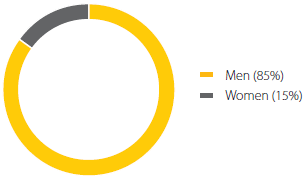 |
The board will address this matter as part of the succession planning programme in 2013.
Chairman
The board is chaired by MC Ramaphosa. Responsibility for managing the board and executive responsibility for the conduct of the business are differentiated. The chairman is responsible for leadership of the board, ensuring effectiveness in all aspects of its activities and setting its agenda. The chairman is responsible for making sure that the directors receive accurate, timely and clear information. The chairman also:
- ensures effective communication with shareholders;
- facilitates the effective contribution of non-executive directors in particular; and
- safeguards constructive relationships between executive and non-executive directors.
No individual board member has unfettered powers in respect of decision making.
The board, on the advice and recommendation of the executive committee, is responsible for setting the strategic direction of the Company. Annually, the board considers, debates and adopts with or without amendments, a strategic plan presented by the executive committee. this plan is further reviewed in the first quarter of each year.
Group president and chief executive officer
RS Dabengwa is the Group president and CEO and is responsible for the day-to-day management of the Group, supported by the executive committee, which he chairs. He provides leadership to the executive team in running the business, co-ordinates proposals developed by the executive committee for consideration by the board, and also develops the Company's strategy for consideration and approval by the board.
Delegation of authority and risk management
The ultimate responsibility for the Group's operations rests with the board. The board retains effective control through a well-developed governance structure of board committees that specialise in specific areas of the business. Necessary authorities have been delegated to the Group president and CEO to manage the day-to-day business affairs of the Company. The executive committee assists the Group president and CEO in discharging his duties and the duties of the board when it is not in session. However, in terms of statute and the Company's constitution, certain matters are reserved for board and/ or shareholder approval. The delegation of authority is reviewed periodically to ensure it remains aligned and relevant in relation to the rapid growth of the Company.
Lead independent director (LID)
Although our chairman is considered independent, the LID has been appointed to further embed the culture of independence of the board. The LID's primary role is to provide leadership and advice to the board without detracting from the authority of the chairman when a conflict of interest arises.
Group secretary
The Group secretary plays a pivotal role in the continuing effectiveness of the board, ensuring that all directors have full and timely access to information and training that equips them to perform their duties and obligations properly and enables the board to function effectively.
The Group secretary's key duties with regards to the directors include, but are not limited to the following:
- Providing counsel and guidance to the board on their individual and collective powers and duties;
- Providing ongoing support and resources enabling directors to extend and refresh their skills, knowledge and understanding of the Group;
- Providing regular updates on effective and proposed changes to laws and regulations affecting the Group and/or its businesses.
In May 2012, the JSE Listings Requirements were amended to provide that with effect from 1 December 2012, company boards must consider and satisfy themselves annually regarding the competence, qualifications and experience of the Group secretary, and also whether she maintains as arm's-length relationship. The performance of the Group secretary, as well as her relationship with the board, are assessed on an annual basis. The Group secretary is not a director of the Company.
The board, with the assistance of the nominations committee and external assurers, have evaluated the Group secretary and is satisfied that she is suitably qualified to fulfil the role.
Details of the qualifications and competencies of the Group secretary are set out below.
| Name | Bongi Mtshali | |
| Date appointed | August 2005 | |
| Qualifications | FCIS and Higher Diploma in Company Law | |
| Previous work experience | Bongi has over 25 years of company secretarial experience. Prior to joining MTN, she worked for Uthingo Management (Pty) Ltd, Telkom Limited, Anglovaal Limited and Anglo American Limited (Gold Division). | |
The board charter
The board charter regulates and details the following key matters:
- Board leadership and defines the separate responsibilities of the chairman and the chief executive as well as the role of the lead independent director;
- Board composition, procedures, pre-requisites and competencies for membership, size and composition of the board;
- Balance of powers;
- The role and responsibilities of the board;
- Board committees' governance;
- Appraisal and performance of the board and its committees; and
- Relationship with stakeholders.
The board charter stipulates that the operation of the board and the executive responsibility for the running of the company's business should be two key and separate tasks and there should be a clear division of responsibilities at the head of the Company to ensure a balance of power and authority, ensuring that no individual or block of individuals has unfettered powers of decision-making or can dominate the board's decisions.
Memorandum of incorporation
The general powers of the directors are set out in the Company's MOI. They have further unspecified powers and authorities in respect of matters that may be exercised and dealt with by the Company and that are not expressly reserved for the members of the Company in general meetings.
Matters reserved for the board
There are certain matters that are dealt with exclusively by the board. These include, but are not limited to, approval of financial statements; the Group's business strategy; the annual capital expenditure plan; major changes to the Group's management and control structure; material investments or disposals; risk management strategy; sustainability and environmental policies; and treasury policies.
Board induction and ongoing development
The Group secretary is tasked with assisting the board with the induction of new directors. All directors undergo a formal induction programme, which outlines their fiduciary and statutory duties and provides an in-depth understanding of the Group and its operations. Re-elected directors are also subject to an ongoing director training and development programme, which includes regular updates and information consultations on legislative and regulatory changes.
Directors are subject to retirement by rotation at least once every three years and may avail themselves for re-election, in accordance with the Company's memorandum of incorporation.
Independence of directors
Determination of independence is guided by King III, the JSE Listings Requirements and common corporate practice.
The chairman of the Group is subject to re-appointment by the board and evaluation of his independence on an annual basis.
Board appraisal
An independent appraisal was conducted by the governance agency Ratings Afrika on all the members of the board and the Group secretary. The appraisal included a peer review as well as a consolidated board appraisal. This process has recently been completed and the board is in the process of reviewing the report to identify areas of improvement.
Board and committee attendance
The MTN Group board recognises that it is ultimately accountable and responsible for the performance and affairs of the Group and that the issue of delegated authorities to board committees and management in no way absolves the board collectively from the obligation to carry out their fiduciary duties and responsibilities. All board committees operate under written terms of reference approved by the board. All committee chairpersons also provide the board with a report on recent committee activities.
Board committees are permitted to take independent outside professional advice as and when deemed necessary. The office of the Group secretary provides support and secretarial services to each of the board committees. Membership of board committees comprises independent and non-executive directors only, with the exception of the executive committee and the Tier II tender committee, which are primarily committees of an operational nature and so comprised of senior management. There is full disclosure and transparency from these committees to the board. The membership and attendance of the committees are set out below. Each committee's authority and the discharge of its responsibilities are directed by a charter.
Attendance register
| Directors | Scheduled board meetings attended |
Special board meetings attended |
Risk, compliance and corporate governance |
Meetings attended |
Remuneration and human resources |
Meetings attended |
Nominations | Meetings attended |
||||||||
| MC Ramaphosa | 4/4 | 5/5 | Member | 3/3 | Chairman | 2/2 | ||||||||||
| KP Kalyan | 4/4 | 5/5 | Member | 5/5 | ||||||||||||
| F Titi# | 2/4 | 3/5 | ||||||||||||||
| MJN Njeke | 3/4 | 5/5 | Member | 3/5 | ||||||||||||
| AF van Biljon | 4/4 | 5/5 | Invitee | Member | 1/2 | |||||||||||
| J van Rooyen | 4/4 | 5/5 | Chairman | 4/5 | ||||||||||||
| A Harper | 4/4 | 5/5 | Chairman | 3/3 | Member | 2/2 | ||||||||||
| MLD Marole | 4/4 | 5/5 | Member | 5/5 | ||||||||||||
| NP Mageza | 4/4 | 5/5 | Member | 5/5 | ||||||||||||
| AT Mikati | 4/4 | 5/5 | Member | 3/3 | Member | 2/2 | ||||||||||
| JHN Strydom | 4/4 | 5/5 | Member | 4/5 | Member | 3/3 | ||||||||||
| RS Dabengwa | 4/4 | 5/5 | Invitee | Invitee | Invitee | |||||||||||
| NI Patel | 4/4 | 5/5 | Invitee | Invitee |
# Appointed with effect from 1 July 2012
In-camera meetings
During the period under review, most of the board and committee meetings were preceded by an in-camera meeting of non-executive directors.
Special ad hoc board committees
In certain instances, the board constituted special board committees, which are granted the necessary authority to deal with the salient matters under special projects and to allow for a more detailed consideration of issues. Special committees may consist of different directors depending on the expertise required to deliberate on any special matters under review by the committee.
Standing board committees
The committees are as follows:
- audit committee (details are set out on page 108)
- risk management, compliance and corporate governance committee
- nominations committee
- remuneration and human resources committee
- social and ethics committee (details are set out on page 96)
- executive committee
The board is satisfied that the board committees as set out in detail below have effectively discharged their responsibilities as contained in their respective terms of reference during the year under review:
Group risk management, compliance and corporate governance committee
The risk management, compliance and corporate governance committee was established to improve the efficiency of the board and assist it in discharging its duties which include the following:
- identifying, considering and monitoring risks impacting the Company; and
- responsible for the sustainability framework and sustainability reporting for the Group.
A close working relationship exists between the risk management, compliance and corporate governance committee and the audit committee. Three non-executive directors serving on the audit committee also serve on the risk, compliance and corporate governance committee. This ensures that overlapping responsibilities are dealt with in an efficient manner. The committee is also responsible for performing the following functions:
Compliance and corporate governance
- To periodically review issues relevant to the board's oversight responsibilities, including compliance with and adherence to the relevant laws and governance standards;
- Review compliance with all local and foreign legislation
and regulatory body requirements applicable to the
Company including but not limited to the following:
– Companies Act
– JSE Listings Requirements
– Governance frameworks
– Health and safety legislation
– Employment equity
– Security Services Act
– Taxation legislation
During the year under review, the JSE had made a few amendments to its listings requirements; the committee assessed the Company's compliance with these requirements and all other statutory and governance codes and was satisfied that it had complied with the requirements. The committee is constituted of independent and non-executive directors only and details of attendance and membership of the committee are set out on page 73.
The remuneration and human resources committee
The committee is constituted as a committee of the board of directors in respect of all duties assigned to it by the board.
The committee oversees the formulation of a remuneration philosophy (policy) and human resources strategy to ensure that the Company employs and retains the best human capital possible relevant to its business needs and maximises the potential of its employees.
Nominations committee
The committee is constituted as a committee of the board in respect of all duties assigned to it by the board.
The committee has been constituted to improve the efficiency of the board in discharging its duties relating to the nomination of board members and senior management. It makes recommendations to the board on the composition of the board and board committees and to oversee the development of directors. In line with the JSE's requirement, the committee is chaired by the chairman of the board.
Executive committee
This committee is constituted as a committee of the board but comprises only executive management and is chaired by the Group president and CEO. The committee facilitates the effective control of the Group's operational activities in terms of its delegated authority approved by the board. It is responsible for recommendations to the board on the Group's policies and strategies and for monitoring their implementation in line with the board's mandate. The committee meets at least monthly and additionally as required. The profiles of the executive committee and subcommittee details are set out on pages 26 to 29.
Audit committee
Social and ethics committee
Details of the audit committee and social and ethics committee are contained in their respective committee reports set out on pages 96 to 98 and page 108 of this integrated report.
External advisers
During the year under review, the board and its committees engaged numerous external advisers who frequently advise the board on a variety of matters that require board consideration and approval.
Regulatory compliance
The MTN Group encompasses operations in 22 countries in Africa, Europe and the Middle East and holding companies in three other jurisdictions. In keeping with its vision and strategy, the Group subscribes to and applies the principles contained in the Code of Corporate Practices and Conduct recommended by King III.
In other jurisdictions where the Company operates, governance developments are monitored on an ongoing basis to ensure that local regulatory requirements are complied with. The board monitors compliance by means of committee reports, which include information on any significant interaction with key stakeholders, including regulators, and through the activities of locally based audit and risk management committees.
The board of directors endeavours to ensure that all operations comply with these corporate governance principles and the requirements of common practices. Likewise, the board places strong emphasis on implementing high standards of reporting, financial and risk management.
The Company's corporate governance systems are aligned with the guidelines of King III and are designed to exceed minimum compliance levels and continue to evolve to meet the expectations of all stakeholders.
Conflicts of interest
A director or prescribed officer is prohibited from using his or her position with respect to the Company or confidential Company information obtained by him or her relating to the Company, in order to achieve a financial benefit for himself or herself or any related third party.
Furthermore, a director or prescribed officer is obliged to make certain disclosures regarding any conflict of interest he or she may have when such arises.
Directors and prescribed officers who have declared a conflict of interest in certain transactions, have voluntarily recused themselves from participating in any manner with regard to those transactions.
Code of business conduct
The MTN Group is committed to promoting the highest standards of ethical behaviour among its directors, management and employees. In accordance with this objective and in the interests of good corporate governance, the code of business conduct is subject to review annually and is cascaded down to all operations.
In addition, the board has also endorsed a social and ethics statement which embodies the Group's values and ethical standards and behaviours.
Sponsor
MTN fully understands the role and responsibilities of the sponsor as stipulated in the JSE Listings Requirements. MTN has a sound relationship with its sponsor (Deutsche Securities (SA) Proprietary Limited) and considers that they have discharged their responsibilities with due care.
| For further details of the governance report please visit our website at |
 |
 |
 |
|