
| Currently viewing: Governance highlights / Next: People and remuneration report |
 |
 |
 |
Downloads |  |
Home |
Governance highlights
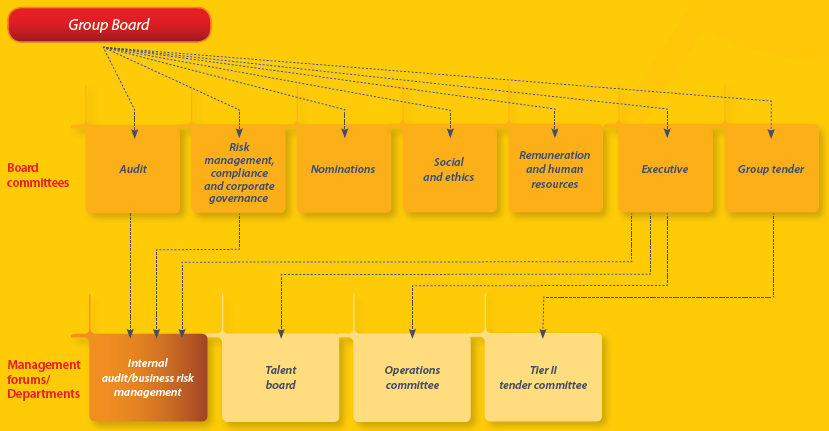
Governance structure This section provides an overview of the Group’s revised governance structure. This structure is also the basis for governance in major MTN subsidiaries. The governance structures of other subsidiaries are currently being reviewed for alignment with the revised operating structure.
Audit committee: AF van Biljon, NP Mageza, MJN Njeke, JHN Strydom, J van Rooyen |
MTN strives to maintain and enhance sound governance practices which are reflective of prevailing international governance trends and the evolving legislative landscape in South Africa. These practices are founded on values of responsibility, accountability, fairness and transparency.
Current year’s initiatives
During 2011, the key focus was the ongoing review of the Group’s corporate governance framework in line with King III, the JSE Listings Requirements and the Companies Act.
With the mandate of the audit committee, the Group engaged PricewaterhouseCoopers Inc. to undertake a review of MTN’s Integrated Business Report for 2010 and the disclosure framework applied therein. This exercise was performed to identify gaps in disclosure and to highlight best practice disclosure requirements that could be considered from the 2011 reporting cycle onwards. Many of the areas identified for improvement have subsequently been addressed.
MTN also acquired a Governance Assessment Toolkit from the Institute of Directors Southern Africa to facilitate a desktop assessment of the Group’s position in relation to compliance and alignment with the dynamic governance landscape in which the Group operates.
| Key compliance achievements | |
 |
|
| Social and ethics committee | The committee has been established, and the inaugural meeting was held in early 2012. The committee’s terms of reference were adopted by the board in the first quarter of 2012. |
| Existing board committees | The board has reviewed and approved a new structure of board committees, which was implemented in the first quarter of 2012. Refer to the Governance structure on page 50. All committees’ terms of reference have been reviewed and adopted by the board in the first quarter of 2012. |
| Board charter | The charter is under review for adoption in 2012. |
| Review of governance policies | Amongst others, the following policies were reviewed:
The insider trading policy has been split into two: (a) the insider trading
policy to ensure that the Group is compliant with all applicable laws and
regulations governing insider trading; and (b) the share dealing policy
which ensures more rigorous restrictions on dealings by directors and the
company secretary of MTN and its major subsidiaries . These policies will
be tabled for adoption in 2012. Other policies that were revised in anticipation of adoption in 2012 were the code of ethics, those relating to prescribed officers, board appointments, independent professional advice and disclosure. |
| Prescribed officers | Prescribed officers have been designated and the policy is being finalised for adoption by the board in 2012. The members of the executive committee (Exco) have been designated as prescribed officers. These designations will be reviewed on an ongoing basis. |
| Alignment of memorandum of incorporation with the Companies Act | The board has constituted a sub-committee charged with the responsibility of reviewing the current memorandum of incorporation for alignment with the Companies Act. |
| Lead independent director (LID) | Although the chairman of the board is an independent non-executive director, for the first time a lead independent non-executive director of MTN was appointed with effect from 14 March 2011. The position was created to further embed the culture of independence of the board of directors especially in instances of perceived conflict of interest. |
| Educating directors, prescribed officers and other relevant staff on the provisions of the Companies Act, King III and JSE Listings Requirements | Numerous sessions were held during 2011 to educate and familiarise directors and officers with the Companies Act and other governance instruments. The sessions were facilitated by independent external advisers and management. |
Although MTN has made significant progress to ensure that King III principles are applied, the following principles were not fully applied:
|
|
| Principle 2.19 – Directors should be appointed through a formal process: | Although MTN’s appointment of directors is transparent and considered by the full board, it does not have a formal policy in this regard. A formal policy will be introduced in 2012. |
| Principle 2.25 – Shares and options should not vest or be exercisable within three years from the date of grant: | The vesting periods for all MTN’s performance share plan (PSP) awards vest after three years. However, the vesting period for the June 2011 PSP awards to a certain category of employees who qualified for allocations as at November 2010, was reduced to a once-off 30 months. |
Board overview and responsibilities
The MTN Group has a unitary board structure comprising a majority of independent non-executive directors. The MTN Group board retains full and effective control over the Group and is responsible, inter alia, for the adoption of strategic plans, the monitoring of operational performance and management, and the development of appropriate and effective risk management policies and processes. The full extent of the board’s responsibilities is contained in an approved board charter. The directors are of the opinion that they have adhered to the terms of reference as detailed in the board charter for the financial year under review. Directors’ profiles appear on pages 16 and 19 of this report.
The roles and duties of the non-executive chairman and the Group president and CEO are separated and clearly defined. This division of responsibilities ensures a balance of authority and power, with no individual having unrestricted decision-making powers.
For further details on responsibilities
of board members, please refer to the
detailed governance report which is
available at www.mtn.com.
Group company secretary
The company secretary is a central source of information and advice to the board and within the Company on matters of ethics, good governance and compliance with rules, regulations and best practice. This is done through the implementation of policies which are communicated and monitored. The Company also ensures that the board is aware of its legal duties. The company secretary is not a director of the Group and has an arm’s length relationship with the board and the directors.
Board appointments and rotation
The nominations committee considers and recommends new appointments to the board. The directors undergo a formal induction programme which outlines their fiduciary duties and provides an in-depth understanding of the Group and its operations. Directors are subject to retirement by rotation at least once every three years and avail themselves for re-election, in accordance with the Company’s memorandum of incorporation.
Independence of directors
Determination of independence is guided by the King Code on Governance for South Africa, the Companies Act, the JSE Listings Requirements and accepted corporate practice.
The board of directors, in the period under review, adopted a policy in line with common practice and King III that a non-executive director who has served at least a nine-year term should be subject to a rigorous annual re-appointment process.
Board effectiveness and evaluation
An internal questionnaire-based evaluation of the board, its committees and individual directors was performed during the year under review. The evaluation covered the size and composition of the board; directors’ induction and development effectiveness and the independence of the chairman; the relationship of the board and management; stakeholder relations; board meetings; the effectiveness of committees; skills needed at the board; visible corporate governance; and peer evaluation.
The overall outcome of the evaluation was acceptable and the board is satisfied with the independence of the independent non-executive directors, including that of the chairman and the LID who have each served on the board for at least nine years. Although the evaluation results were satisfactory, areas for improvement were identified. These include, amongst others, enhancement of board composition by considering appointment of members with industry background; director selection and appointment; director development; and succession planning at board level. The areas of improvement are being addressed by the chairman, LID and the company secretary.
The evaluation of the board by an external service provider is performed every two years and will next be undertaken in 2012.
Succession planning
Board succession is being addressed. The board, through the nominations committee, is performing a comprehensive assessment of the skills base in the current board of directors. This will facilitate board succession planning to ensure that the board has the requisite skills for transitioning in the next three to five years.
During 2011, an executive succession list was considered and supported by the board through the former nominations, remuneration, human resources and corporate governance committee.
Board committees
The MTN Group board recognises that it is ultimately accountable and responsible for the performance and affairs of the Group and that the issue of delegated authorities to board committees and management in no way absolves the board and its directors from the obligation to carry out their fiduciary duties and responsibilities. All board committees, as detailed in the graphic on page 50, operate under written terms of reference approved by the board. Each committee’s authority and the discharge of its responsibilities are directed by a charter. All committee chairpersons also provide the board with a report on recent committee activities.
The audit committee assists the board in its duties relating to the safeguarding of assets, the operation of adequate financial systems and control processes, and the preparation of financial statements and related financial reporting in compliance with all applicable legal requirements and accounting standards.
The remuneration and human resources committee oversees the formulation of a remuneration philosophy and human resources strategy to ensure that the Company employs and retains the best human capital possible relevant to its business needs.
The nominations committee oversees improvement of efficiency to the board in discharging its duties relating to the nomination of board members and senior management as well as board and board committee’s composition and oversees development of directors.
The board is satisfied that the board
committees have effectively
discharged their responsibilities as
contained in their respective terms
of reference during the year under
review. Details of the committees
are given in the full corporate
governance report at
www.mtn.com
Special ad hoc board committees
In certain instances, the board constitutes special board committees which are granted the necessary authority to deal with the salient matters under special projects and to allow for a more detailed consideration of issues. Special committees may consist of different directors depending on the expertise required to resolve any special matters under review by the committee.
A detailed corporate governance
report is available on
www.mtn.com.
| Directors | Scheduled board meetings attended |
Special board meetings attended |
Audit | Meetings attended |
Risk | Meetings attended |
NRHR & CG | Meetings attended |
Ad hoc committees |
Meetings attended |
|||||||||||
| Independent non-executives |
|||||||||||||||||||||
| MC Ramaphosa | 4/4 | 5/6 | Member | 4/4 | |||||||||||||||||
| DDB Band+ | 1/1 | 1/1 | Chairman | 1/1 | |||||||||||||||||
| KP Kalyan | 4/4 | 6/6 | Member | 4/4 | Member | 3/4 | 1/1 | ||||||||||||||
| MJN Njeke | 4/4 | 5/6 | Member | 4/4 | Member | 4/4 | |||||||||||||||
| AF van Biljon | 4/4 | 6/6 | Chairman | 4/4 | Invitee | 3/4 | Chairman | 8/8 | |||||||||||||
| J van Rooyen | 4/4 | 6/6 | Member | 4/4 | Chairman | 4/4 | Chairman/member | 4/5 | |||||||||||||
| A Harper++ | 4/4 | 5/6 | Chairman | 4/4 | Member | 1/1 | |||||||||||||||
| MLD Marole | 4/4 | 5/6 | Member | 4/4 | Member | 1/1 | |||||||||||||||
| NP Mageza | 4/4 | 5/6 | Member | 4/4 | Invitee | 3/4 | Member | 7/8 | |||||||||||||
| Non-executives | |||||||||||||||||||||
| AT Mikati | 4/4 | 6/6 | Member | 4/4 | |||||||||||||||||
| JHN Strydom | 4/4 | 6/6 | Member | 4/4 | Member | 4/4 | Member | 8/8 | |||||||||||||
| Executives | |||||||||||||||||||||
| PF Nhleko+++ | 1/1 | 1/1 | Invitee | Invitee | Invitee | ||||||||||||||||
| RS Dabengwa | 3/4 | 5/6 | Invitee | Invitee | Invitee | ||||||||||||||||
| NI Patel | 4/4 | 5/6 | Invitee | Invitee |
| + | Resigned on 11 March 2011 in order to reduce his directorships/workload. |
| ++ | Succeeded DDB Band as chairman of NRHR & CG. |
| +++ | Resigned on 31 March 2011 following expiry of term of contract of employment. |
Group tender committee members (including independent non-executive chairman)
| Member | Committee member since |
Scheduled meetings |
|||
| WA Nairn | 08/2010 | 6/6 | |||
| RS Dabengwa* | 05/2004 | 3/6 | |||
| A Farroukh | 09/2011 | 1/6 | |||
| F Laher | 10/2011 | 4/6 | |||
| NI Patel | 11/2009 | 6/6 | |||
| J Ramadan | 06/2007 | 6/6 | |||
| I Sehoole | 12/2010 | 6/6 |
* Resigned as a member on 7 October 2011 by virtue of the fact that the Group president & CEO is not eligible to serve on the Group tender committee. RS Dabengwa’s membership of the committee was in his capacity as the former Group chief operating officer.
Risk management, compliance and corporate governance committee
The committee identifies, considers and monitors risks impacting the Group and ensures compliance with prevailing legislation and other statutory requirements (including voluntary corporate governance frameworks). The committee is also responsible for the sustainability framework and reporting to the Group. Three of the five nonexecutive directors serving on the committee including the committee chairman also serve on the audit committee, to ensure that overlapping responsibilities are dealt with in an efficient manner.
Risk management
As a group that operates in and understands emerging markets, MTN believes that risk management and internal control are fundamental to effective corporate governance and the development of a sustainable business.
MTN’s objective has been to instil greater risk awareness throughout the organisation, and to standardise the approach to risk management i.e. identifying, assessing, mitigating and reporting risks.
MTN is in the process of implementing the King III requirements with regards to risk management, specifically the aspects of combined assurance and IT governance. Group business risk management (BRM) initiated a project in 2011 to implement a revised assurance process in order to agree the principal risks facing the organisation and to conclude and report on the residual risk rating for each identified principal risk. With the implementation of a Combined Assurance Model, MTN will ensure that assurance activities throughout the organisation are standardised.
Independent business risk management function
Business risk management is an independent function responsible for the disciplines of enterprise risk management, internal audit and fraud risk management and coordination of combined assurance across the Group. The business risk management function has a staff complement of more than 200, comprising risk, internal audit, fraud risk and forensic specialists across the 21 operating countries of which more than two thirds are internal audit specialists. The internal audit discipline within business risk management is independent from the risk management discipline.
MTN has business risk management functions in all of its operations with oversight from the Group business risk management function.
Group business risk management is headed by a Group chief business risk officer who reports to the Group president and chief executive officer and has direct access to and has regular meetings with the chairpersons of the Group audit committee and Group risk management and compliance committee.
The activities of the business risk management function are guided by a set of policies, frameworks and methodologies which have been approved by the Group audit committee and Group risk management and compliance committee.
Combined assurance As a public listed company the MTN Group always tries to keep abreast with best practice and aims to review and improve its governance practices, transparency and accountability. The implementation of new King III requirements is an important part of this initiative.
MTN is in the process of implementing a full combined assurance approach in line with best practice and King III.
This approach will ensure that maximum value is extracted from the various assurance providers including first line of assurance (management), second line of assurance (risk management, including proactive fraud risk management) and third line of assurance (internal and external audit, reactive fraud risk management).
Combined assurance will provide an integrated approach to managing the principal risks that face the organisation. Assurance from all the lines will be mapped to the principal risks and will allow the exco as well as the Group board to obtain an improved view of the mitigation of risk in the organisation as well as the state of the control environment. The combined assurance methodology will be phased in and will be applicable to the MTN Group, all MTN operating companies, and MTN joint ventures and subsidiaries.
During the year under review, progress was made with the customisation and implementation of a risk management software solution to support the combined assurance approach and to ensure improved analysis, monitoring and reporting of risks.
Risk appetite
MTN’s risk appetite is determined by the type of risk, which allows for a more controlled approach to managing risk levels. A formal risk escalation structure was implemented based on MTN’s riskbearing capacity and a set of risk thresholds at various levels in the Group. These risk thresholds are reviewed and updated annually. Aggregation of total risk is done qualitatively and the Group risk management and compliance committee assesses the acceptability of MTN’s consolidated risk profile.
Enterprise risk management
The Group business risk management function is responsible for ensuring the existence of an effective framework for risk management and driving the implementation of this framework throughout the Group. This is done by assisting and advising management on the topic and by ensuring effective reporting and escalation of risks.
The process of risk management in the Group is guided by a risk framework which is based on best practice risk management procedures. This framework formed the basis of the Group’s revised combined assurance methodology.
The Group business risk management function, together with management, has the mandate and responsibility of ensuring that adequate risk management processes are implemented in all areas of the business in line with the risk framework.
Insurance and risk transfer
MTN has a comprehensive insurance programme in place which covers perils such as physical/material damage, business interruption, political risk, public liability, directors’ and officers’ liability, crime and professional indemnity. The limits of indemnity for these covers have been structured to ensure that MTN has adequate cover for its risks but similarly to ensure that the Group gets maximum value from the programme and that premium spend is kept under control.
MTN also believes that risk retention and self-insurance are necessary to keep premiums at reasonable levels and show commitment towards risk management. MTN’s retention levels differ from policy to policy, guided by the nature of the risk being transferred.
IT governance
IT governance has always been an important aspect of the control environment in MTN as the Group is technology driven. However, in line with the new chapter in King III, MTN is in the process of improving and formalising certain aspects of its IT governance framework.
The challenge at MTN has always been the implementation of governance requirements across a globally diverse organisation.
As such, an RACI matrix has been established to identify the roles and responsibilities of the board and its sub-committees in order to implement IT governance at MTN within the existing governance organisation. A mandate to establish accountability with the committee holding the highest authority for IT within the sub-committees of the board is also underway. The delegation of IT governance responsibilities will then follow on the basis of different functional responsibilities and outcomes.
The Group has embarked on a shared services model to improve technology efficiency and cost synergy. This will form an integral part of the IT governance framework in future along with aspects such as information security, data privacy and business continuity.
The IT governance position at MTN is well on its way but in its infancy. We aim to establish a comprehensive framework by the end of the 2012 year.
Fraud risk management
The management of fraud risk within the MTN Group remains the responsibility of business risk management and more specifically the fraud risk management service line (FRM) located therein. FRM continues to mature with greater emphasis and focus on responding to fraud risk on a more proactive-versus- reactive basis.
The proactive monitoring of significant fraud risks has become an established routine in all significant MTN operations and greater traction was achieved during the year in ensuring that smaller operations start proactively managing fraud risk. The tip-offs anonymous whistleblowing line has been well established and is now available in 15 MTN operations.
The year has seen the formal integration of the FRM methodology into the internal audit and risk management disciplines via the introduction of combined assurance. This will result in a greater cohesion between FRM, internal audit and risk management. Group FRM has also developed a groupwide electronic case management system via the new ERA system. The case management system will not only provide an electronic platform for recording cases, but will ensure that forensic findings are tracked, allocated to responsible line management, and are considered during the rating of principal risks.
The UK Bribery Act came into effect during 2011 and BRM is looking at revising or drafting new policies to deal with this legislation in the context of the MTN Group and the applicability of this legislation to MTN.
FRM will concentrate on the following inherent fraud risk areas and FRM strategies during the year:
 |
Mobile Money; |
|
procurement fraud; |
|
airtime fraud and related IT security weaknesses; |
|
standardisation of reactive investigation methodologies; |
|
various fraud awareness initiatives; and |
|
further formalisation of proactive fraud risk monitoring and consolidation throughout the MTN Group. |
Internal audit
MTN has a substantial internal audit function which is responsible for providing independent internal audit assurance to the Group Exco and board. The independence of the internal audit discipline is maintained and internal audit work is ultimately governed by the Group audit committee, within an internal audit charter. In future, internal audit will form an integral part of third line assurance in the combined assurance methodology. Internal audit activity in the Group has increased constantly over the past few years with total internal audit hours in 2011 rising to over 166 000 from 130 000 in 2010. Internal audit assurance is guided by extensive risk evaluation. Projected internal audit hours for 2012 are in excess of 166 000 hours. The Group is now at the point where internal audit coverage is extended to most operations and all high-risk processes.
Total internal audit hours

|