
| Currently viewing: Operational performance: Iran / Next: Operational performance: Ghana |
 |
 |
 |
Downloads |  |
Home |
Operational performance: Iran
for the year ended 31 December 2011
All numbers reflect MTN’s 49% share other than subscriber numbers.
|

Performance overview
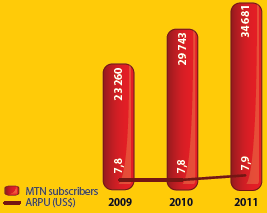
MTN Irancell delivered a sound performance, increasing its subscriber base by 16,6% in a market where penetration increased to above 100%. The growth was mainly attributable to lower denomination vouchers and seasonal promotions, increasing market share to 45%. The improved distribution of airtime through ATMs has also contributed to higher spend by subscribers.
Total rial revenue grew 26,5% for the year. Airtime and subscription revenue increased 22,8% while interconnect revenue increased 11,4% as the quality of the network improved. Data revenue (excluding SMS) gained momentum, increasing 66,5% off a low base. SMS revenue growth remained robust at 47,0%. ARPU increased by 2,0% to $7,9 and by 5,6% in local currency terms.
The EBITDA margin showed a healthy expansion of 1,2 percentage points to 42,5% as MTN Irancell continues to maintain a low operating cost base. Distribution and commission costs also reduced as physical recharge vouchers were replaced by logical airtime distribution. These savings were partially reduced by a large increase in rent and utilities following the removal of government subsidies and the increase in fuel prices.
A weaker rial resulted in lower rand reported revenue growth of 20,1% and EBITDA growth of 24,1%.
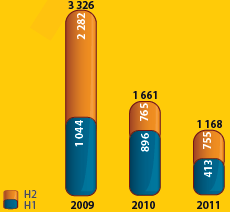
MTN Irancell continued to invest in its network, improving quality and capacity although rollout of some projects has been slower than anticipated because of delayed equipment delivery. MTN Group’s share of capital expenditure amounted to R1 168 million, lower than that guided at the time of the interim results. Population and geographic coverage increased to 77% and 23% respectively. Seven hundred and eighty-one 2G BTSs were added in the year bringing the total to 7 640.
Regulatory update
MTN Irancell maintained its active engagement with the authorities in the year as it continues to seek clarity from the authorities on issues such as the right to provide 3G services.
During the second half of the year, the company received additional number ranges required to meet demand. Although a licence was issued to a third mobile operator in 2010, this new entrant only launched its services in a limited area late in 2011.
Sustainability
Sustainable economic value – Electronic airtime charging, e-shopping and m-health are some of the value-added solutions offered over MTN Irancell’s GPRS and WiMax infrastructure.
Eco-responsibility – MTN Irancell’s carbon footprint is 89,9 tonnes CO2e per annum. Most sites are powered by the national grid, and only a few sites run on diesel generators. In an effort to reduce emissions and extend services in rural areas, MTN Irancell has invested in 35 off-grid sites, 25 of which use solar power. In one district, GPRS power meters are used to report energy consumption remotely. MTN Irancell is also making greater use of outdoor network sites, switching off lights after hours and using free cooling and site insulation to manage heat and cooling exchanges.
Sustainable societies – MTN Irancell addresses health and safety through random audits of EMF at network sites, by avoiding building sites close to schools and hospitals, and ensuring compliance with health and safety rules. MTN encourages enterprise growth through its local empowerment procurement plan. All recharge vouchers and SIM cards are sourced locally.
|