
| Currently viewing: Operational performance: South Africa / Next: Operational performance: Nigeria |
 |
 |
 |
Downloads |  |
Home |
Operational performance: South Africa
for the year ended 31 December 2011

|

Performance overview
MTN South Africa performed well for the year, increasing its subscriber base by 16,9% to 22,0 million. This was mainly due to growth of the prepaid base by 17,6% to 18,2 million subscribers. The postpaid segment grew mainly in the second half of the year, increasing subscribers for the year by 14,0% to 3,8 million. Hybrid packages were the primary contributor to growth in this segment together with telemetry SIMs. SIM and revenue market share declined marginally in the first half of the year but recovered in the second half, with signs of an upward trend.
Total revenue increased 7,7% due to strong growth in data revenue, which was up 27,7% (excluding SMS), as well as growth in total airtime and subscriptions of 4,2%. Prepaid airtime and subscription revenue increased 14,0%. The 45,3% growth in handset revenue was a result of robust demand for both entry-level handsets and smartphones. Data revenue (excluding sms) now contributes 12,0% of total revenue. At the end of the year, there were 5,5 million 3G devices on the network which included 3,6 million smartphones as well as 1,4 million dongles and other data devices. Interconnect revenue declined 9,8% following the reduction in mobile termination rates. Average revenue per user per month (ARPU) reduced 12% primarily due to lower interconnect revenue and more lower-revenue SIMs, including telemetry.
MTN South Africa EBITDA margin increased 1,2 percentage point to 35,2% for the year. This was mainly the result of cost savings in general expenses, professional and consulting fees, as well as lower marketing and advertising costs.
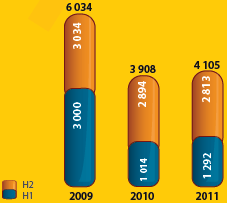
Capital expenditure for the period was marginally ahead of the Group’s guidance at R4 105 million as MTN South Africa continued to modernise the network by introducing IP technology to improve network quality. There were 313 2G and 598 3G base transceiver stations (BTS) added during the year, bringing the total BTSs to 9 785. Fibre rollout remains a priority with the national long-distance fibre project still underway. At the end of December, 89% of the Johannesburg to Durban route was trenched, as was 86% of the Johannesburg to Bloemfontein route and 58% of the Bloemfontein to Cape Town route. MTN South Africa has embarked on a pilot of 103 long-term evolution (LTE) base stations in line with its future LTE deployment strategy.
Regulatory update
MTN has met the Regulation of Interception of Communications Related Information Act which required all subscribers to register their personal details by June 2011. By the deadline, MTN South Africa had registered more than 90% of its subscriber base.
ICASA introduced radio frequency regulations in the year which was followed by an invitation to apply for the high demand 2,6GHz and 800MHz frequency band spectrum needed to offer LTE services. MTN has submitted comments, although the spectrum allocation decision has been delayed by ICASA.
In March 2011, MTN reduced its termination rates in line with the call termination regulations glide path to 73 cents from 89 cents.
Sustainability
Sustainable economic value – MTN South Africa’s effective BEE ownership is more than 44% mainly through the MTN Zakhele scheme. MTN South Africa focused on data integration solutions in 2011, offering value-added solutions such as the MTN Opera Mini Browser for faster downloads and Pay-D, which enables mobile phones to be used as point of sales terminals for online debit card purchases. Through MTN Play, it offered retail clients enhanced information for work, life, learning and fun. MTN Business extended its data offerings to include solutions for air and water quality monitoring, as well as a number of telepresence, cloud computing and smart office management tools for corporate clients.
Eco-responsibility – MTN South Africa’s carbon footprint is 165 000 tonnes CO2e per annum. This has declined as a result of various initiatives and processes to actively reduce energy use and switch to alternative power. MTN is complementing its 2 MW tri-generation plant in Johannesburg, launched in 2010, with a 4 MW site in Pretoria. The company also has 22 off-grid solar, wind, biomass and hybrid BTS sites. Its holistic approach to network energy management includes smart metering, free cooling, battery monitoring and rapid site deployment.
Sustainable societies – MTN South Africa uses software filtering to address customer cyber security concerns. It has met its BBBEE targets for enterprise development, procuring goods from SMEs and has obtained a level 2 contributor rating from Empowerdex. In the year, it spent almost R48 million on community investment projects in education, health and the arts.
|