
| Currently viewing: Operational performance: Ghana / Next: Operational performance: Syria |
 |
 |
 |
Downloads |  |
Home |
Operational performance: Ghana
for the year ended 31 December 2011

*Other income is 100% profit from sale of the Ghana towers.
|

Performance overview
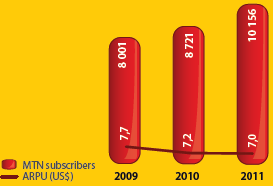
MTN Ghana delivered a solid performance as subscribers increased by 16,5% to 10,2 million. This was mainly attributable to attractive promotions including bonus on recharge offers which included “weekend super saver” and a “10 million subscriber promo”. Market share declined marginally to 52% from 53% but is considered satisfactory given the very competitive nature of the market.
Total cedi revenue increased 15,1% for the year. This was mainly due to a 13,9% increase in airtime and subscription revenue and a 35,1% increase in interconnect revenue. Data revenue (excluding SMS) continued to gain traction, albeit off a low base, increasing 79,7%, while SMS revenue decreased 43,4% due to regulatory requirements to change SMS promotions. ARPU declined 2,8% to $7,0 while in local currency ARPU increased 3,5%.
MTN Ghana’s EBITDA margin, excluding the profit from the sale of the towers, decreased 6,2 percentage points to 36,6% in rands and 38,1% in local currency as interconnect costs rose more than interconnect revenue due to competitive off-network tariffs. EBITDA margin was also negatively impacted by an increase in transmission and utility costs. Although there was an increase in lease costs, the full impact of the new tower arrangements will only be incurred in 2012.
A weaker cedi against the dollar resulted in a lower rand reported revenue growth of 5,1% to R5 941 million while EBITDA decreased 13,2% to R2 172 million, excluding the sale of the towers.
Capital expenditure for the period amounted to R851 million. The lower spend was mainly due to the change in structure following the establishment of the tower company. 430 2G and 125 3G BTS’s were rolled out for the period. The company continued to prioritise capacity and quality on the network as traffic increased, although quality of service remains a challenge.
Regulatory update
In the year, mobile number portability regulations were passed into law.
In line with subscriber registration regulations, MTN Ghana registered the details of more than 10 million subscribers, representing 99% of its total users by year end.
In November, the Ghana Telecom Chamber was launched to represent the industry. It continues to pursue cases filed against some metropolitan centres for what mobile operators consider to be arbitrary business operating permit fees.
The National Communications Authority (NCA) imposed penalties on all operators for what it said was a failure to meet network performance indicators. Operators paid the fines, but continue to dispute the methodologies adopted by the NCA in measuring quality of service. A communication service tax on local interconnect charges, also considered a form of double taxation, is also being contested.
In December, the NCA announced new interconnect rates effective 2012 to 2014. These rates are lower for the two smallest operators in the market until the end of 2014.
Sustainability
Sustainable economic value – by developing affordable and innovative ICT services, MTN Ghana makes a socio-economic difference while growing its revenues. Among these are MTN Mobile Money, m-health, MTN Zone, m-insurance, MTN Opera Mini Browser, m-agriculture, a telecoms management solution for refugee crises and natural disasters, and community payphones. It also has a partnership with the UN to distribute credit for food using mobile phones powered by solar and other kinetic (bicycle) power. It continues to roll out 3G technologies.
Eco-responsibility – although MTN Ghana has outsourced its network sites, the company continues to account for the energy and carbon intensity of these sites. Its carbon footprint is 31,7 tonnes CO2e per annum.
Sustainable societies – MTN Ghana invested over R32 million on various initiatives in health and education and national priority areas such as environmental conservation in 2011. It won the Group’s 21 Days of Y’ello Care trophy for its employee volunteering programme which centred on the goals of the UN International Year of Sustainable Forestry. It used TV game shows and other media to build awareness of this issue.
|