
| Currently viewing: Operational performance: Nigeria / Next: Operational performance: Iran |
 |
 |
 |
Downloads |  |
Home |
Operational performance: Nigeria
for the year ended 31 December 2011

|

Performance overview
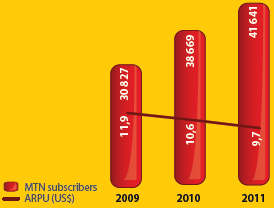
MTN Nigeria faced a challenging year with aggressive price competition and mandatory SIM registration process. This had a negative impact on gross connections for the entire market. Network quality again became a focus area for the regulator as higher elasticity from lower pricing impacted traffic demand across almost all of the networks. Notwithstanding these challenges, the company increased its subscriber base by 7,7% to 41,6 million and ended the year with a more stabilised market share of 50%. There is no clarity on the deadline for SIM registration although the regulator has initiated a process to form a central database of registration records.
Total naira revenue increased 9,6% mainly driven by a 54,5% increase in interconnect revenue. This was a result of continued changes in traffic patterns during the year as cheaper off-network prices were offered tactically by the competition. More competitive tariffs by MTN in the second half of the year have partially stabilised the traffic mix. Data revenue (excluding SMS) grew 105% as more data packages were introduced to the market. MTN Nigeria has 1,7 million smartphones and 330 000 dongles on the network. Airtime and subscription revenue increased only 3,7% due to a reduction in effective tariffs which was not fully compensated by a proportionate increase in minutes of use. ARPU declined by 8,1% to $9,7 and by 5,3% in local currency terms.
MTN Nigeria’s EBITDA margin declined by 1,2 percentage points to 61,7% when compared to the prior year. Higher operating costs were mainly the result of a 25% increase in the average diesel price as well as increased site rental and SIM registration costs (professional fees).
The marginally weaker naira against the rand negatively impacted rand reported revenue growth for the year resulting in only a 4,1% increase in revenue to R34 879 million. Reported EBITDA increased 2,2% to R21 536 million.
Network rollout improved in the second half of the year, with the company adding 529 2G and 453 3G BTSs in the year bringing the total number of BTS’s to 9 131. Capital expenditure amounted to R6 331 million compared to R4 700 million in 2010. Corrective action and measures have been put into place to ensure that capital expenditure programmes are delivered more effectively. MTN Nigeria rolled out an additional 1 312 km of fibre in the year and connected fibre to 90 sites in support of its data strategy.
Regulatory update
Among the regulatory highlights in the year, MTN Nigeria secured approval for a new mobile number range as well as permission to build new sites in over 150 locations.
The NCC enhanced its monitoring of mobile operators’ quality of service (QoS) and issued letters to three mobile operators including MTN, expressing concern and potential implications of poor QoS in late 2011. MTN Nigeria has improved network quality since and has put measures in place to ensure quality is fast tracked and maintained. This was acknowledged by the authority.
By year-end, in line with regulations, MTN Nigeria had successfully registered the personal details of over 34 million subscribers, representing over 83% of the active subscriber base.
Nigerian regulations limit the role of telecommunications companies in mobile payments. However, MTN continues to engage with the NCC and the central bank to find a commercial solution. It is also engaging on plans for the implementation of mobile number portability and the ongoing review of the national telecoms policy.
Sustainability
Sustainable economic value – MTN launched MTN Mobile Money in Lagos in the year, using a slightly different model. This will ultimately be extended across the country in 2012 to help address access to financial services. Nigeria is the largest social media user on the continent, and mobile phones facilitate this. MTN’s Opera Mini Browser has been taken up widely, with some customers reporting substantial reductions in their data costs .
Eco-responsibility – MTN Nigeria depends on diesel to operate its base stations. Its carbon footprint is 460 tonnes CO2e p.a. However, it has embarked on a drive to reduce this dependency by introducing hybrid power solutions for generators and connecting 1 000 rural base stations to the national power grid. 254 sites have so far been connected, saving over 1 300 litres of diesel a month. MTN has reduced the number of staff vehicles, introducing new buses and more bus routes for staff in an effort to reduce carbon emissions. MTN uses biodegradable recharge cards.
Sustainable societies – MTN Bizlift supports more than 53 000 SME retailers with business ideas and access to finance and sales material. MTN Village Phone has helped more than 4 500 vendors, mostly women, benefit from selling airtime. In 2011, MTN Nigeria invested more than R39 million on education, health and enterprise development. It has developed various policies to support the company’s zero-tolerance approach to corruption.
|