|
 |
|

|
| You are here: Remuneration report / Next: An interview with our Group president and CEO |
Remuneration report
MTN’s remuneration philosophy aims to deliver a
competitive, differentiated and flexible pay structure as
a means of attracting, rewarding and retaining highquality
individuals. We believe investment in human
capital must be commensurate with performance. The
optimum mix of competencies, abilities, experiences and
skills needed to achieve our overall strategic priorities are
considered when selecting an individual. To achieve this,
in 2013, the human resources (HR) team worked to
improve the alignment of its practices to meet business
priorities, encouraging a culture of individual and team
performance as well as creating a great place to work.
Some of the key initiatives included delivering service
excellence to our employees and creating a common
culture across the Group through instilling vital behaviours
see page Our philosophy also includes recognising those good behaviours which lead to successful achievement of business results. Employees who actively demonstrate living the vital behaviours and values are recognised using the various recognition programmes. Where results are achieved, we reward employees through short and long-term incentive schemes. Our reward mechanisms are informed by best practice, innovation and effective service delivery. Our traditional recognition platform “Yello Stars” was placed on hold during 2013, and a refreshed perspective is currently under review to incorporate more cross-functional recognition options where peer-to-peer, top-down and bottom-up options are introduced.
MTN’s remuneration and human resources (R&HR) committee is delegated responsibility by the board to make sound remuneration decisions that are aligned to the Company’s strategy and acceptable governance principles. In executing its duties, the committee consults external experts as and when necessary, although the committee takes the final decision with regard to the interests of stakeholders. The committee ensures that:
The committee constantly reviews the remuneration strategy and policy to ensure that these principles remain applicable to the dynamics of the business and in accordance with legislative stipulations. Full details of the committee’s terms of reference and key
focus for the year under review are outlined in the
corporate governance report on pages
MTN’s remuneration strategy is designed to attract and retain the skills required to meet our strategic priorities. To achieve our strategy a Total Reward model that is compelling, flexible and compliant to legislation is implemented across all Company geographies in line with our philosophy. Although competitive financial rewards are key to attracting employees, a diversified basket of our total reward benefits is where we attain competitiveness in retaining employees. We believe that a strategy and its policies are ineffective without a solid foundation of delivering on our philosophy. MTN’s reward decisions are therefore hinged on the principles of pay fairness, transparency and competitiveness. With a strong high-performance culture, operating in the ICT space demands that we strategically and significantly incentivise high performers, but cautiously managing affordability to fund such payments. While we aim to maintain internal pay equity, the Company does not commit to the remuneration of employees on the principle of equality, as pay differences will always exist and are influenced by the demand and supply of skills as well as the job-related compensatible factors that each candidate possesses. Executive pay benchmarking It is essential that the leadership employed by the Group has the necessary skills and expertise to execute the Group’s strategic priorities. We benchmark executive salaries against relevant global competitors. The quantum and mix of salaries for our exco members and the operations’ CEOs are set against the Company size, job complexity, turnover and market rates. As and when justified, we review executives’ annual guaranteed packages against carefully selected benchmark companies. In addition to the external benchmarks, the internal pay scale serves as guidance when positioning packages. During 2013, MTN made key executive leadership changes
at Group level as part of the Company’s talent management
strategy. Where applicable, it was necessary for the
committee to review and align executives’ packages with
their new roles. Details of the executive team structure are
provided on page
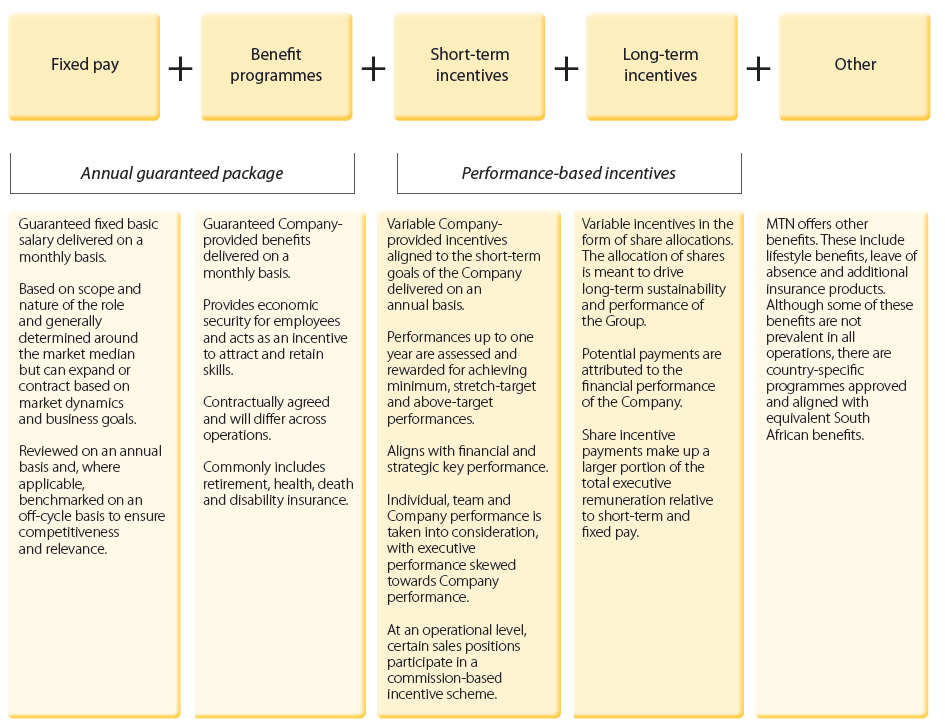
The Company subscribes to an annual guaranteed package approach. This includes cash and benefits in kind which, when combined with incentive payments and other non-quantifiable elements, make up what we term “Total Reward”. Our fixed pay component is defined by general worth of skills while incentive payments are based on short and long-term performance. The table below summarises the various pay components which collectively make up Total Reward.
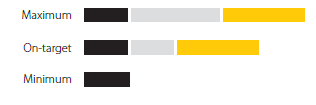
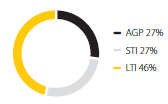
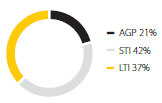
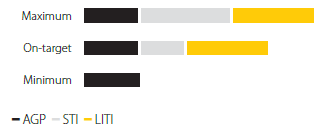
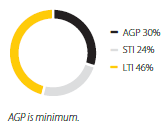
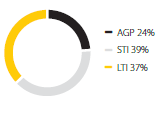
Generally, employees based in South Africa are remunerated on an annual guaranteed package (AGP) approach, which includes a combination of base remuneration and benefit provisions, commonly referred to as fixed remuneration. The Group has implemented this approach subject to labour regulations and remuneration practices. Non-South African-based operations have adopted and customised the AGP approach in accordance with local practices and regulations. Executive pay composition Executives at MTN are remunerated by taking cognisance of the short-term and long-term objectives of the Company. Executives are compensated using an optimal combination of fixed pay, short-term variable as well as long-term incentives. This supports alignment of strategy and their behaviours. The mix is aimed at ensuring that executives proportionately achieve an optimal balance of remuneration when executing their duties. The following graphs illustrate the mix of minimum, on-target and the potential maximum compensation for the Group president and CEO and the Group chief financial officer.
As illustrated above, the proportion of AGP to performance-based incentives varies between the Group president and CEO and the Group CFO. Both roles comprise a higher weighting on performance incentives “risk pay” and less on their guaranteed package. The Group’s integrated performance framework (IPF) guides the execution of business strategy by providing a framework through which the day-to-day and annual performance levels are set, cascaded and measured according to the business strategic themes.
Short-term incentives General staff and executives participate in an annual
performance-based bonus plan. The principles of the
bonus plan are aligned to the performance achievements of the Company, team and individual priorities. Group
priorities are derived from the yearly business plan and
budgets. These priorities are aligned to the Group’s
strategic themes and are delegated to members of the
exco team who are responsible for driving, supporting
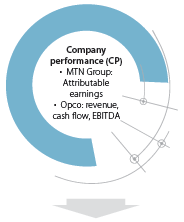
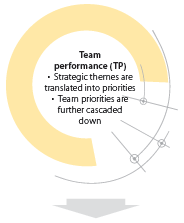
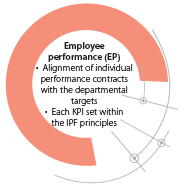
and facilitating the execution of priorities. Page The process of determining the incentive award pools from which performance bonuses are paid is illustrated below
The process of determining the incentive award pools from which performance bonuses are paid is illustrated below. Calculating bonuses The following steps are considered when calculating bonuses:
The calculation methodology used in computing the final bonus payable to employees participating in the bonus plan as illustrated below. (CP + TP + EP) times on-target percentage
Bonus parameters The executive bonus parameters governing the bonus plan are summarised below:
Long-term incentive schemes (LTIS) Long-term incentive schemes are designed to retain key and senior employees by aligning their long-term contribution to the success of the Company with the interests of shareholders. The Group operates a combination of an equity and cash-settled scheme for its eligible workforce where the value gain represents appreciation in the performance of the Company. In calculating the long-term incentive, the value of the award is expressed as a percentage of fixed remuneration. The potential pay-outs differ according to participant levels. Since 2001, the Group has implemented the following schemes:
Please refer to “notes to the Group financial statements” for additional information.
In 2012, MTN appointed Investec Share Plan Services (ISPS) to host the online Group share scheme’s administration platform. The ISPS platform not only provides a real-time trading platform for participants, but also supports the Company’s digital endeavours where the highest levels of service delivery are achieved using available tools. In 2013, the administration team embarked on a robust process to finalise data migration from the previous administrators to ISPS. To obtain an objective view of the functionality of the platform, the ISPS system underwent an internal audit check with the assistance of the business risk function. The outcome of the audit was presented to the Group share trustees and management and showed satisfactory results. After the completion of the system built early in 2013, trading in MTN shares was re-opened on 6 March 2013 immediately after the announcement of Group results. Accordingly, trading by eligible employees was conducted via the online system, where participants with matured options and rights used this platform to view and execute trades. The following sections provide a view of the allocation dates under the Group equity schemes.
Employees are generally eligible to participate in these schemes if they have met a minimum continuous service criterion within MTN and have not reached their retirement age at the date of allocation. Participation in these schemes is subject to the approval of the R&HR committee. In addition, MTN reserves the right to exclude participation by certain employees by virtue of their employment status, e.g. disciplinary, suspension, dismissal. A summary of previous allocations and the vesting dates is presented below: Equity share schemes vesting schedule
Key: ✓ Allocation date ◆20% tranche vested (cumulative) ★30% tranche vested (cumulative) Further details on the performance measurement,
assessment periods, and settlement criteria are available
under the ”notes to the Group financial statements”
MTN non-equity schemes for employees in non-listed operations outside South Africa MTN offers non-South African-based employees participation in the Group’s notional share option (NSO) scheme. This scheme enhances MTN’s commitment to the “One Group, One MTN” philosophy. Qualifying employees own options and also participate in the growth of the Group and its operations, as applicable. The main objective of the NSO scheme is to encourage an alignment between the individual interests of senior employees and the long-term success of the Group. Thus the scheme design rewards employees for the value gain derived from the NSO price per share appreciation between the allocation and vesting dates. The NSO scheme was reviewed in 2013 and a proposal was presented to the R&HR committee to change the mechanics of the scheme to align it with the Group equity schemes. The committee supported this recommendation and operations will make NSO allocations under the new rules effective 1 April 2014. The key aspects and changes of the NSO scheme include:
The R&HR committee is responsible for advising on the remuneration of non-executive directors, including reviewing remuneration recommendations as put forward by the executive committee in consultation with external remuneration consultants. The committee also recommends the remuneration for approval by the board and shareholders. The remuneration for NEDs is considered annually and is determined in light of market practice and with reference to the time, commitment and responsibilities associated with the roles. MTN Group’s non-executive directors receive an annual
retainer and a meeting attendance fee. They do not
participate in any type of incentive scheme nor do they
receive any medical and pension-related benefits. The
remuneration paid to NEDs on page
MTN’s expatriate pay model was reviewed in order to introduce a greater degree of relative internal pay equity across the various operations. The choice of the United Arab Emirates as the Global Employment Company for purposes of expatriate compensation management afforded the opportunity to standardise hypothetical expatriate base pay levels in all countries within one pay structure in a hard currency. This base pay foundation is consistent for all assignees with only country specific dynamics being added on, resulting in an MTN framework which represents a balance between relative equity across the Group, and local relevance. MTN continues to use more local talent in operating companies. The year-on-year decrease in the number of expatriates was 13% from December 2012 to December 2013.
Contracts and severance: MTN’s policies regarding Group executive employment contracts dictate the period of the contract as well as the notice of termination. Presently, the Group president and CEO and the Group CFO have entered limited duration contracts. The inclusion of a period of restraint in the employment contract is generic and no specific timeframes are indicated. Notice of termination for Group executives is three months, unless otherwise specified.
During 2013, the executives’ contracts of employment did not contain any specific restraint of trade provisions. To protect the interests of the Company, we revised our employment contract structure to include a provision of a restraint of trade agreement for a six-month period. This provision was introduced to safeguard the Company against situations where employees terminate their services with MTN and seek new employment with a competitor. Effective 2014, new appointments will be contracted on the revised contract basis, which also includes an extended notice of termination for executives of six months.
Directors’ and prescribed officers’ emoluments and
payments in the tables presented below have been
audited. Full details on directors’ and prescribed officers’
emoluments, equity compensation benefits for executive
directors and directors of major subsidiaries in respect of
the share appreciation rights and share rights schemes
can be found in the Directors’ emoluments and related payments For the year ended 31 December 2013
For the year ended 31 December 2012
1 Includes medical aid and unemployment insurance fund. For the year ended 31 December 2013
For the year ended 31 December 2012
1 Fees paid in euro. Prescribed officers’ emoluments and related payments For the year ended 31 December 2013
For the year ended 31 December 2012
1 Retired 31 January 2013. |
|||||||||||||||||||||||||||||||||||||||||||||||||||||||||||||||||||||||||||||||||||||||||||||||||||||||||||||||||||||||||||||||||||||||||||||||||||||||||||||||||||||||||||||||||||||||||||||||||||||||||||||||||||||||||||||||||||||||||||||||||||||||||||||||||||||||||||||||||||||||||||||||||||||||||||||||||||||||||||||||||||||||||||||||||||||||||||||||||||||||||||||||||||||||||||||||||||||||||||||||||||||||||||||||||||||||||||||||||||||||||||||||||||||||||||||||||||||||||||||||||||||||||||||||||||||||||||||||||||||||||||||||||||||||||||||||||||||||||||||||||||||||||||||||||||||||||||||||||||||||||||||||||||||||||||||||||||||||||||||||||||||||||||||||||||||||||||||||||||||||||||||||||||||||||||||||||||||||||||||||||||||||||||||||||||||||||||||||||||||||||||||||||||||||||||||||||||||||||||||||||||||||||||||||||||||||||||||||||||||||||||||||||||||||||||||||||||||||||||||||||||||||||||||||||||||||||||||||||||||||||||||||||||||||||||||||||||||||||||||||||||||||||||||||||||||||||||||||||||||||
 8
8