|
 |
|

|
| You are here: Our corporate governance highlights / Next: Remuneration report |
Our corporate governance highlightsStatement of commitment Good corporate governance is an integral part of the Group’s sustainability. Adherence to the standards and recommendations set out in the King III Report and other relevant laws and regulations is vital to achieving our strategic priorities. Corporate governance forms an overarching framework in which our business operates and we are committed to promoting good governance and ethics within all areas of our business. To achieve this, the Group continues to enhance and align its governance structures, policies and procedures to support its operating environment and strategy. Key governance developments for the year under review:
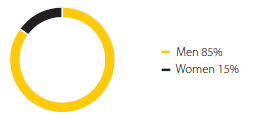
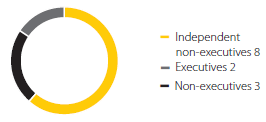
The board is comprised of an appropriate mix of executive, non-executive and independent non-executive directors, who are diverse in their academic qualifications, industry knowledge and experience, race and gender. This diversity enables directors to provide the board with the relevant judgment to work effectively when conducting and determining the business affairs of the Company. The roles and duties of the non-executive chairman and the Group president and CEO are separated and clearly defined. This division of responsibilities ensures a balance of authority and power, with no individual having unrestricted decision-making powers.
The MTN Group board retains full and effective control over the Group and is responsible, inter alia, for the adoption of strategic plans, the monitoring of operational performance and management, and the development of appropriate and effective risk management policies and processes. The full extent of the board’s responsibilities is contained in an approved board charter. The directors are of the opinion that they have adhered to the terms of reference as detailed in the board charter for the financial year under review. The board, on the advice and recommendation of the exco, is responsible for setting the strategic direction of the Company. Annually, the board considers, debates and adopts with or without amendments, a strategic plan presented by the exco. This plan is further reviewed in the first quarter of each year. The non-executive directors play a critical role as board representatives on the various board committees and ensure that the Company’s interests are served by impartial, objective and independent views that are separate from those of management and shareholders. Chairman The responsibility for managing the board and executive responsibility for the conduct of the business are separated. The chairman is responsible for the leadership of the board, ensuring effectiveness in all aspects of its activities and setting its agenda. It is the responsibility of the chairman to ensure that directors receive accurate, timely and reliable information. The chairman also ensures that no individual board member has unfettered powers in respect of decision making. Lead independent director (LID) Due to the fact that our chairman had been employed by the Group in an executive capacity within the preceding three financial years, he is not considered independent. The LID, AF van Biljon, provides guidance to the board in situations where the impartiality of the chairman is impaired or when a conflict of interest arises. Delegation of authority The ultimate responsibility for the Group’s operations rests with the board. The board retains effective control through a well-developed governance structure of board committees that specialise in specific areas of the business. RS Dabengwa is the Group president and CEO and is responsible for the day-to-day management of the Group, supported by the exco. Necessary authorities have been delegated to the Group president and CEO to manage the day-to-day business affairs of the Company. The exco assists the Group president and CEO in discharging his duties and the duties of the board when it is not in session. However, certain matters are reserved for board and/or shareholder approval. The delegation of authority is reviewed periodically to ensure it remains aligned and relevant in relation to the rapid growth of the Company. Group secretary The Group secretary plays a key role in the continuing effectiveness of the board, ensuring that all directors are provided with adequate guidance on governance and applicable laws. She also ensures that directors have full and timely access to information and training that equips them to perform their duties and obligations properly and enables the board to function effectively. The performance of the Group secretary, as well as her relationship with the board, is assessed on an annual basis. The board, with the assistance of the nominations committee, has considered the competencies, qualifications and experience of the Group secretary and also whether she maintains an arm’s-length relationship. The board is satisfied that she is suitably qualified to fulfil the role.
The board has approved a board charter which outlines the mandate of the directors. It stipulates that the operation of the board and the executive responsibility for the running of the Company’s business should be two key and separate tasks and that there should be a clear division of responsibilities at the head of the Company to ensure a balance of power and authority, ensuring that no individual or block of individuals has unfettered powers of decision making or can dominate the board’s decisions.
The general powers of the directors are set out in the Company’s Memorandum of Incorporation. They have further unspecified powers and authorities in respect of matters which may be exercised and dealt with by the Company, which are not expressly reserved to the members of the Company in general meetings.
All directors undergo a formal induction programme, which outlines their fiduciary and statutory duties and provides an in-depth understanding of the Group and its operations. Re-elected directors are also subject to an ongoing director training and development programme, which includes regular updates and informative consultations on legislative and regulatory changes.
Directors are subject to retirement by rotation at least
once every three years and must avail themselves for re-election,
in accordance to the Company’s Memorandum
of Incorporation. For details on rotation in 2014, see
page
The majority of directors is independent. The chairman and all the non-executive directors are subject to an annual review of independence. Following the review of independence, directors who have been appointed on the board for a period in excess of nine years are subject to re-election.
The MTN Group board recognises that it is ultimately accountable and responsible for the performance and affairs of the Group and that the issue of delegated authorities to board committees and management in no way absolves the board and its directors from the obligation to carry out their fiduciary duties and responsibilities. All board committees operate under written terms of reference approved by the board. All committee chairpersons also provide the board with a report on recent committee activities. The committees are as follows:
Attendance of scheduled and ad hoc meetings Board members are required to attend all scheduled
meetings of the board, including meetings called on an
ad hoc-basis for special matters, unless prior apology
with reasons has been submitted to the chairman or
Group secretary. Ad hoc meetings are convened at short
notice and therefore directors are not always available
to attend. Attendance register
Ad hoc committee meetings are not included in the register. The board is satisfied that the board committees, set out in detail below, have effectively discharged their responsibilities as contained in their respective terms of reference during the year under review. The committees’ profiles are detailed as follows:
External advisors The board and its committees make use of external advisors who advise on a variety of matters that require board consideration and approval. Code of business conduct The MTN Group is committed to promoting the highest standards of ethical behaviour among its directors, management and employees. In accordance with this objective and in the interests of good corporate governance, the code of business conduct is cascaded down to all operations.
MTN recognises that risk management and internal control are an integral part of good corporate governance. MTN’s overall governance structure and integrated risk management framework guides the operation of our business units, which are primarily responsible and accountable for risk management. MTN’s objective is to instil greater risk awareness throughout the organisation; to standardise the approach to risk management and to embed the process into the day-to-day running of the business. Business continuity and crisis risk management Business continuity management (BCM) establishes a fit-for-purpose strategic and operational framework that:
BCM’s understanding at the organisation’s highest level will ensure that the objectives of MTN’s operations are not compromised by unexpected disruptions. Through a proper and proactive BCM process, MTN ensures effective measures are in place to protect its people, facilities, technology, information, supply chain, stakeholders, reputation and brand. With that recognition, MTN can then take a realistic view on the responses that are likely to be needed as and when a disruption occurs, so that it can be confident that it will manage any consequences without unacceptable delay in delivering its products or services. Insurance and risk transfer The MTN insurance programme is built around the close connection between risk management and insurance using an annual assessment of risk management at each operating company. To achieve this, there is a strong commitment to risk management assessment, improving operational management’s adoption of risk management best practice and to reduce risks across the entire insurance programme. MTN has a comprehensive insurance programme in place that covers perils such as physical/material damage, business interruption, political risk, public liability, directors’ and officers’ liability, crime and professional indemnity. The limits of indemnity for these covers have been structured to ensure that MTN has adequate cover for its risks but at the same time ensure that the Group gets maximum value from the programme and that premium spend is efficient. MTN also believes that risk retention and self-insurance are necessary to keep premiums at reasonable levels and show commitment towards risk management. MTN’s retention levels differ from policy to policy, guided by the nature of the risk being transferred. Information and technology governance MTN acknowledges information and technology as integral strategic assets to the business in delivering a bold new digital world to its customers. MTN’s commitment to sound governance is supported by the ongoing activities and efforts in embedding the King III Code of Corporate Governance principles and recommendations, with specific focus on technology governance through the establishment of various responsibilities, processes and supporting governance structures. A Group information security officer (GISO) has been appointed and charged with the responsibility for managing and monitoring the Group-wide information security programme. Adequate effort at all levels and proper risk management practices will continue to ensure that technology governance is fully integrated across all MTN operations and that current and emerging information security risks, such as cyber security and data privacy, are proactively addressed. Fraud risk management The MTN Group fraud risk management strategy is based on the three core elements of prevention, detection and response to fraud, bribery and corruption-related risks. The proactive management of fraud risk is embedded into MTN Group enterprise risk management processes and also informs the residual rating and consideration of risk on a principal risk level. MTN operating companies are required to identify, monitor, mitigate and report on significant fraud risks on a continual basis. All MTN stakeholders have access to the Deloitte Tip-offs Anonymous website (www. tip-offs.com) and email address (anonymous@tip-offs.net) to report fraud and corruption while 19 operations have an established and dedicated whistleblowing line. In 2013, MTN received 687 whistleblowing reports about fraud and other administrative matters. The MTN fraud risk management framework ensures that every whistleblowing report is reviewed, investigated accordingly and reported to the audit committee where applicable and relevant. Current and emerging fraud risks such as mobile financial services, cybercrime and procurement fraud continue to be assessed and monitored. Internal audit The MTN Group and all its subsidiaries embrace the principles of The King III Report and recognise the significant opportunities that present themselves to companies that do so. Internal audit’s role is that of an objective and independent value-adding assurance provider that embraces a riskbased auditing approach in line with King III to the Group exco and board. It considers the risks that may hamper the achievement of strategic priorities and further determines the effectiveness of MTN’s system of internal control and risk management. MTN’s internal audit has adopted a combined assurance model as a coordinated approach to all assurance activities. MTN has dedicated teams that perform internal audits across MTN and its subsidiaries. Internal audit reports functionally to the audit committee and administratively to the Group president and CEO. Its independence is explicitly stated within the business risk management charter. Internal audit assurance is guided by extensive and proactive risk assessment. Internal audit coverage is extended to all operations and all high-risk processes in line with the internal audit methodology. In 2013, more than 180 000 hours were spent on internal audit and for 2014 we expect that internal audit activities will exceed 201 370 hours. |

 .
. 
 91
91