|
 |
|

|
| You are here: An interview with our Group president and CEO / Next: Group strategic analysis |
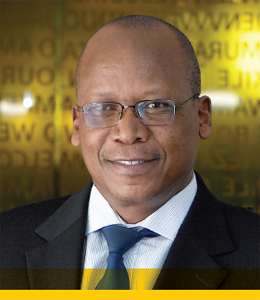
An interview with our Group president and CEO
In the face of fierce price competition and increased regulatory pressure in many of our key markets, our Nigerian operation continued to improve its performance during the year and we made some notable progress in our South African operation in the second half of the year. Our large opco cluster performed well, with particularly encouraging growth reported by our operations in Uganda, Ghana, Cameroon, Iran and Sudan. In our small opco cluster, results from Zambia and Yemen were particularly good. I am also pleased with the traction we gained in many of our strategic initiatives, particularly in growing our business in the digital space and achieving growth beyond traditional voice. We made good strides in driving our data offering and increased data revenue by 41,4% to R20 670 million, which means it now contributes 15,1% to total revenue. This was achieved by extending our 3G coverage and facilitating the use of more data-enabled devices on our network. At year end, we had 34,8 million smartphones on our network. We expect the recent launch of our own affordable “Steppa” smartphone in South Africa to help quicken the pace of smartphone penetration. To accelerate MTN’s expansion into the digital space, we partnered with Rocket Internet (Rocket), a deal which is expected to be concluded in the first half of 2014. This will enhance growth in our internet business in Africa and the Middle East as Rocket is one of the world’s leading internet incubators, with a presence across our footprint. Our partnership was effected through two separate agreements. Firstly, a partnership arrangement was established with Rocket and Millicom International Cellular to develop our internet businesses in Africa, through Africa Internet Holdings (AIH). The second agreement involved Rocket and MTN becoming 50% shareholders in Middle East Internet Holding. We also continue to leverage our integrated ICT business, which is still in its infancy and is envisaged to increase its contribution going forward. Currently, we provide cloud services to SME customers in seven markets and high speed networks in 11 markets. During 2013, we secured two large multinational contracts in Africa and a partnership with PCCW, owners of one of the world’s largest IP backbones, which will allow us to enhance our ICT offering in Africa. Other highlights include the successful execution of our capex programme, which significantly improved network quality and capacity, and facilitated higher voice and data traffic. We also continue to be innovative and targeted in our service offering to customers. This means that we remain relevant and protect our revenue base.
Our operating environment remained challenging as we continued to experience highly competitive mobile markets and increased regulatory pressures. We are confident that our substantial investment in network infrastructure and MTN’s attractive value proposition will ensure that we continue to deliver sustainable growth. Competition helps create a vibrant market place and we welcome it. However, while we will remain competitive on price, we strongly believe that we should rather compete on value to ensure that retail tariffs fairly reflect the cost of providing advanced communication services and thus safeguard industry sustainability. A key lesson in 2013 was the success of MTN’s segmented targeted offerings that allowed us to compete more effectively without focusing on price. Innovation is central to maintaining a competitive advantage and we have implemented a number of initiatives to support this, such as our investment in the Amadeus IV Digital Prosperity Fund as well as establishing an integrated platform to ensure that opcos share ideas and best practice. Similarly, a seamless network experience is critical to our leadership position. In 2013, the Group spent R30,2 billion in capital expenditure, rolling out 5 161 2G sites and 4 413 3G sites. Our South African operation continued to experience strong competition and a difficult regulatory environment. Encouragingly we started to see some improvement in performance in the second half of 2013, supported by more relevant segmented offerings to the pre-paid segment and improvements in cost optimisation. MTN Mobile Money and financial services are becoming an increasingly important part of our service offering. We are not only focused on acquiring subscribers but also on increasing the volume of transactions and expanding our product range to include short-term insurance, ATM withdrawals and remote payments for airline tickets. In 2013, growth in MTN Mobile Money subscribers was lower than expected, due in part to regulatory issues and operational challenges. This will be an area of management focus in 2014.
We are pleased with MTN Nigeria’s performance in late 2013. It delivered revenue growth of 5,7%* and subscriber growth of 19,7%. This is a particularly good result after adjusting for the 3,2 million disconnections we had to make in line with the mandatory subscriber registration programme, and the disconnection of service in three northern states, which closed on 30 June 2013. A highlight of the year was the appointment of Michael Ikpoki as CEO of MTN Nigeria. We aim to ensure sustainable MTN Nigeria profitability by focusing on network optimisation and customer retention. Capex execution also remains central as we continue to invest for growth. In 2013, we brought 2 743 2G sites and 1 607 co-located 3G sites on air. We also continue to expand our offering with innovative products and services, such as an mHealth partnership with Hello Doctor and the launch of mInsurance. Data contributes 15,1% to total revenue. The number of smartphones on the network increased by 63,1% to 6,2 million at the end of December. Looking ahead, we will be better placed to expand our data offering as we continue to invest in the 3G network. Importantly, we have experienced a more constructive engagement with the regulator as we continue to seek consistent and realistic network performance targets.
In 2013, we made solid progress on cost optimisation across the Group, which assisted in the increase in our EBITDA margin to 43,1%**. As the telecommunication environment continues to evolve towards data and as competition intensifies, revenue will come under pressure. It is therefore imperative that we embed cost optimisation and efficiencies into the business to ensure that we have the most effective cost base for future growth and profitability. A number of initiatives have already resulted in real cost benefits. These include centralising procurement, reducing costs in our distribution network through the renegotiation of contracts in South Africa and the realignment of our commission structure in Nigeria. Optimising employee numbers in all operations as well as moving more base stations onto the national grid and introducing hybrid power, are other steps that we have taken to optimise costs. In 2013 we started the process to establish a global hub for centralised transaction processing in South Africa.
MTN has a sufficiently large balance sheet to allow for flexibility in our allocation of capital. Importantly, we measure the different uses of our capital against acceptable return on invested capital (ROIC) and return on equity (ROE) levels. The different uses of capital are viewed on a case-by-case basis and investment is decided on individual merits. We aim to have an efficient balance sheet and it is regularly reviewed by both the board and the exco. Our key funding considerations include:
We continue to work to repatriate funds from Iran and Syria, while complying with international sanctions legislation.
The success of MTN is built on the calibre of its people and the ability to offer an exciting employee value proposition (The MTN Deal) that ensures we attract, develop and retain top talent as a source of competitive advantage and differentiation. As we enter the new digital world, MTN maintains a strategic focus to ensure it has the right talent and capabilities to deliver on its new mission and vision. To this end, we invest extensively in skills and training through the MTN Academy to maintain our competitive edge and develop effective, transformational leaders. We also constantly benchmark our HR practices and remuneration policies against global standards. As a large organisation spread over a number of countries, we focus on embedding what we consider to be vital MTN behaviours across our business to support our strategy and create a common organisational culture. This is underpinned by a number of internal roadshows, as well as face-to-face quarterly reviews where management and employees can learn from each other and share best practice. Instilling ethical standards and conduct is critical. In 2013, we made good progress in introducing and standardising policies and building up our ethics management capability across our operations
Being a responsible corporate citizen and ensuring a sustainable marketplace is important to us. During the year, we committed 70% of our total CSI expenditure of R314 million to education projects, particularly ICT projects and the digitisation of education. Over the next two years, we plan to spend R200 million on improving the quality of education across our markets. We will also continue to support initiatives in the areas of health and economic empowerment as well as those areas of each operations’ particular national priority. Relevant sponsorships are made to support our communities’ interests.
MTN has many favourable prospects. We believe leveraging technology and delivering more services via the internet is the greatest source of opportunity, particularly as internet penetration across our footprint is still low. We aim to increase our presence in the digital space and take advantage of growth in data traffic and ICT solutions. Expanding our 3G coverage, as well as access to affordable data-enabled devices, will continue to drive data usage. We will maintain our focus on MTN Mobile Money and broader financial services as well as providing innovative ICT solutions to corporate and SME customers though our enterprise business unit. We will also sustain our voice business through dynamic tariffing, bundled packages and innovative value-added services. As competition intensifies, we will remain competitive by improving network quality and capacity and providing innovative and value-added products targeted at our different customer segments. We are targeting a continuous improvement in customer experience as measured by our net promoter score. In 2013, we recorded a 28% increase in this measure in the countries where it has been rolled out already. We are focused on transforming our organisation through cost optimisation and increasing operational efficiency. There also remain a number of opportunities to leverage our partnerships in adjacent industries and explore value-accretive M&A activities. Sifiso Dabengwa 11 March 2014 |