|
 |
|

|
| You are here: Message from our Group chief financial officer / Next: Financial review |
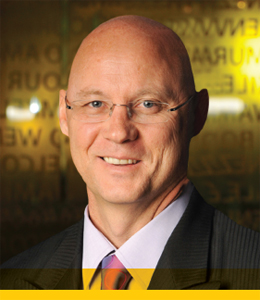
Message from our Group chief financial officer
MTN ended 2013 on a promising note. The operational
performances of both the large and the small opco
clusters were strong in the year, MTN Nigeria posted
a sharp recovery in the second half and there were
some encouraging signs for a better 2014 from MTN
South Africa, despite the challenges it faces. Details on
operational performance can be found on pages The analysis of operational performance shows that despite the bolstering effect of rand weakness on reported results, a decline in revenue and profitability in our South African operation, and subdued growth in our Nigerian business for the year as a whole weighed on the Group overall. These two operations account for nearly two-thirds of Group revenue and so their performance significantly impacts our reported results. We made good progress in reducing costs as part of our strategic efforts to transform our operating model. For the year, we achieved savings of US$450 million through the centralised procurement initiative, in line with our target. 2013 also marked the year I assumed the role of Group chief financial officer and it gives me great pleasure to present our financial results, details of which appear in the pages that follow. Reported results from operations outside our South African home base, particularly those in Nigeria, Ivory Coast, Cameroon and Uganda, were supported by the rand’s weakness against the US dollar, and more specifically against the currencies of these countries. On average, the rand lost 18% against the US dollar in the year, and 16% against the Nigerian naira. It lost 17% against the currencies of Cameroon and Ivory Coast, 13% against that of Uganda, and 9% against the Ghanaian cedi. Furthermore, the naira held its ground against the dollar, ebbing just 2% in the year. In order to mitigate the effects of currency volatility on the Group’s earnings, where possible, MTN manages foreign currency translation risks primarily through utilising borrowings denominated in the relevant local currencies. A particular highlight of the year was the successful raising by MTN Nigeria of a syndicated loan facility, the equivalent of US$3 billion, of which some US$2,1 billion was denominated in naira. Seven international and 17 local financial institutions participated in this, one of the country’s largest recorded syndicated loans for a corporate, in support of our capital expenditure programme in Africa’s most populous nation. Where possible, the Group’s operations use forward contracts to hedge their actual exposure to foreign currency, largely related to contracts for capital equipment. For example, our Nigerian subsidiary places foreign currency on deposit as security against letters of credit when each order for imports is placed. In the year ahead, we plan more active treasury management across the Group. In 2013, MTN recorded foreign exchange gains of R1,1 billion, compared to losses of R2,7 billion in 2012. This helped support growth in headline earnings per share (HEPS), which increased by 27,3%. Our final dividend for 2013 increased by 25,6%, confirming our strategic commitment to creating and managing stakeholder value by providing sustainable shareholder returns without compromising the ability of the Group to invest and grow its operations. This payout exceeds the absolute growth in dividends of between 5% and 15% normally adopted by the Group. This is partially a result of exceptional forex gains during the year. The Group did not buy back any shares in the year, after spending approximately R3 billion in 2012 and 2011 on purchasing MTN stock in the open market. We will continue to consider share buy-backs on an opportunistic basis.
Looking at the results for each operation on a constant-currency basis provides a clearer picture of the underlying performance of each business. These details show the strong second half recovery in Nigeria, where we were able to secure stable tariffs, supported by the regulator’s maintenance of a floor for market tariffs. This improved performance was also supported by significant infrastructure investment by MTN Nigeria to ensure improved network quality and capacity.
The efficient and effective management of the Group’s liquidity, working capital and currency exposure continues to be a key focus. The step up in our dividend during 2013 as well as the M&A partnerships have seen some, albeit small, increase in our net gearing.
As part of our efforts to comply with evolving International Financial Reporting Standards, we made some changes in our disclosures in the year. We now account for all joint ventures, most notably MTN Irancell, using equity accounting methodology. And in compliance with IAS 29 Financial Reporting in Hyperinflationary Economies, our Iranian operation’s results were adjusted in 2013 for the high levels of inflation in that country.
In the year ahead, we will continue to focus on optimising costs and reaping the rewards of our various initiatives in this regard. These include the roll out of shared services platforms, managed services, centralised procurement as well as the adoption of new procurement practices. While historically the main focus of centralised procurement has been on capex, in 2014, the predominant focus will be on opex savings. We will continue our work to support the strategic priorities of increasing MTN’s role in growing revenue streams in the digital space and adjacent sectors. This will be achieved through establishing appropriate revenue-sharing agreements with new partners, as well as by facilitating acquisitions and ensuring the allocation of sufficient capital to guarantee an appropriate return on investment. With more management focus on the small opco cluster, we see an opportunity for improved returns from these operations, which collectively could make a more positive contribution to overall Group results going forward. 2014 will see specific attention given to treasury management as we aim to further optimise our funding while at all times managing risk appropriately. With increased pressure on tariffs for both voice and data, management is increasingly focused on balance sheet metrics. I am looking forward to the year ahead as we continue on our journey to deliver a bold, new Digital World to all of our customers. Brett Goschen 11 March 2014 |
 58 to 63