Top risks to value creation

Our top risks

Using an integrated assurance methodology, in 2017 we considered the following to be MTN's most material risks based on the residual risk rating of each. This takes into account the probability of the risk occurring, the impact should it materialise and the mitigation strategies in place. Rankings change during the year, however, each of these risks receives equal management attention.
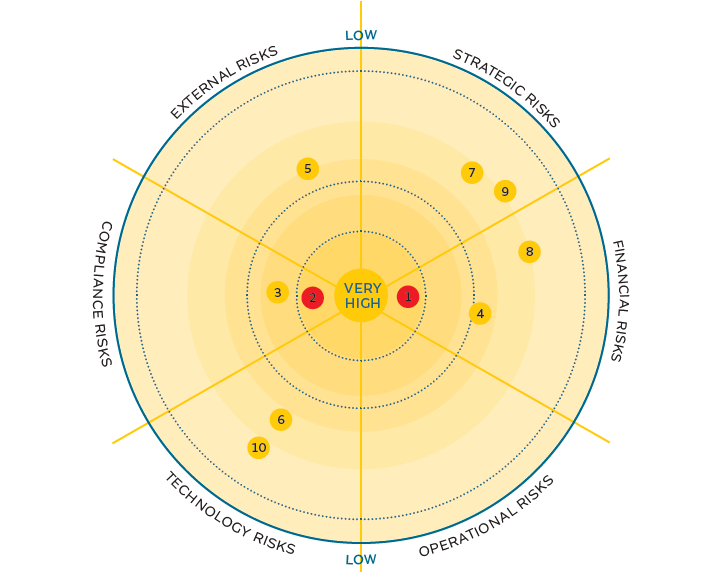
Our top risks

         
RISK       RISK DESCRIPTION  
  • 1
      Foreign exchange volatility and weakening currencies  
  • 2
      Operational and compliance risks  
  • 3
      Increased regulatory pressures  
  • 4
      Suboptimal cash generation and upstreaming to the group  
  • 5
      Political and economic risk in our key markets: South Africa, Nigeria and Iran  
  • 6
      Spectrum cost and availability  
  • 7
      Ability to successfully execute large group strategic and change programmes  
  • 8
      Returns on capex deployed  
  • 9
      Optimisation of investment portfolio  
  • 10
      Increasing cyber and information risks  


Risk rank^ Risk name and impact if not managed Mitigation and opportunities Link to
strategy
MTN’s achievements in 2017    
1

Foreign exchange volatility and weakening currencies

Currencies in our operating markets have in many instances been volatile. This leads to opex and capex pressures in opcos and eventually impacts the group's profitability. Furthermore, weaker currencies in our operating markets result in translation losses on rand-reported results.

  • Stress test 2018 to 2020 business plans against currency volatility to understand volatile areas and implement responsive measures.
  • Use hedging instruments where available and economically feasible.
  • Use best efforts to maximise levels of local currency debt as opposed to that denominated in foreign currency.
  • Convert large contracts into local currencies where possible.
  • Continued to explore opportunities to convert foreign-denominated contractual commitments into local currency commitments in various markets.
  • Maximised rand-denominated funding at a holding company level to improve our currency mix of debt in line with our funding philosophy, including significant issuances under our domestic medium-term note programme.
  • MTN Ghana secured 510 million cedi facility.
   
2

Operational and compliance risks

Amid increasing regulatory requirements (particularly in respect of subscriber registration, mobile financial services and so forth) non-compliance could lead to strained relationships with regulators, reputational damage, disruption of services and the loss of customers. Furthermore, weaknesses in the control environment could lead to operational risks and losses.

  • Implement a model to separate second and third lines of assurance in the organisation.
  • Further embed leading risk, compliance and control practices and roll out new compliance framework.
  • Enhance control environment in certain business areas such as enterprise business unit, MTN Mobile Money and value-added services.
  • Developed a new model and obtained board approval to separate and strengthen second and third line assurance functions throughout the group.
  • Strengthened risk and control KPIs in performance agreements for senior management. This resulted in a significant increase in accountability for internal controls and a major reduction in overdue audit findings.
  • Strengthened risk escalation mechanisms through the introduction of a risk escalation and acceptance policy.
  • Strengthened mechanisms to monitor key risk indicators.
  • Implemented a group-wide risk control software solution.
  • Strengthened the compliance function through the introduction of a dedicated policy and procedure focus and the approval for a significant increase in headcount across the group.
   
3

Increased regulatory pressures

We have businesses in a large number of jurisdictions and must comply with an extensive range of laws and regulations, including licence conditions and renewals, subscriber registration and data privacy requirements. These pressures continue to increase and are often elevated by economic conditions and other difficulties in our markets. The cost of compliance is very high, impacting revenue and profitability.

  • Continue to build strong relations with key stakeholders and regulators.
  • Implement a dedicated group regulatory management function and regulatory framework to improve proactiveness and maturity of regulatory engagements.
  • Strengthen opco regulatory functions by adding new resources and upskilling existing ones.
  • Continue to strengthen subscriber registration infrastructure and further embed new data privacy requirements.

  • Strengthened the group regulatory function and its oversight over opcos.
  • Established multidisciplinary teams to ensure targeted focus on aspects such as subscriber registration, spectrum management and mobile financial services.
   
4

Suboptimal cash generation and upstreaming to the group

In addition to generating profitable returns, it is also vital for our operations to generate sufficient cash to fund capital-intensive programmes and repatriate earnings to the group. An inability to repatriate earnings (due to factors such as a shortage of foreign currency, stringent exchange laws and sanctions) may impact our ability to keep adjusted group leverage stable and to increase distributions to shareholders.

  • Focus on attaining double-digit service revenue growth (in constant currency) and improving EBITDA margins.
  • Manage capex intensity through the implementation of the new smart capex programme.
  • Optimise working capital and cash management practices.
  • Optimise cash balances in opcos and cash upstreaming to the group.
  • Strengthened KPIs on cash management and upstreaming at opco and group level.
  • Commenced with the implementation of the smart capex programme.
  • Successfully repatriated cash from a number of markets, in particular repatriation of R6,5 billion from Iran and resumption of dividends from Nigeria, receiving R1,4 billion in 2017 after 2016's liquidity crisis.
  • Maintained a sufficient level of committed facilities at an opco and group level to respond to market stress scenarios.
   
5

Political and economic risk in our key markets: South Africa, Iran and Nigeria

Despite recent improvements, political and economic conditions in South Africa still pose a risk of a further downgrade of the sovereign credit rating. This in return could impact MTN's cost of funding and the performance of MTN South Africa.

Deteriorating relations between the US, Saudi Arabia and Iran may lead to further sanctions and/or pressure on the Iran nuclear deal, which in return may negatively impact MTN's interests in Iran.

Furthermore, political instability and sanctions in a number of MENA countries increase the risk of profitability fluctuations and uncertainty in respect of fund repatriation.

  • Ensure sufficient levels of committed funding facilities at group level to respond to market stress scenarios.
  • Ensure appropriate mix of fixed and floating rate funding.
  • Mitigate forex risks through measures described in risk number 1.
  • Continuously monitor developments across MENA and perform ongoing scenario and sensitivity analyses to navigate difficult conditions.
  • Maintain the group's approach of self-funding of MENA operations and maximise cash repatriations.
  • Closely monitor compliance to sanctions policies.
  • Ensure continuity of operations, protect staff and assets through strong business continuity management measures.
  • Successfully negotiated new funding facilities and maintained a high level of funding headroom through various facilities.
  • Continued to explore opportunities to convert foreign-denominated contractual commitments into local currency commitments in various markets.
  • Performed liquidity stress testing on multiple scenarios during 2018 business planning process.
  • Continued to operate successfully without any major incidents to staff or assets despite difficult conditions in certain MENA countries.
   
6

Spectrum cost and availability

Non-availability of adequate spectrum has a direct impact on our quality of service and ability to deliver on our dual-data strategy.

An increased cost of spectrum impacts the cost of our products and services and puts pressure on margins.

  • Co-ordinate and liaise closely with regulators for acquisition of spectrum in line with recently refined spectrum plan.
  • Continue to explore ways to enhance spectrum planning and usage optimisation.
  • Ongoing cost benefit analysis of spectrum acquisition focusing on products/services and their pricing.

  • Proactively engaged with regulators on cost and acquisition of spectrum.
  • Intensified engagement with South African regulator and ministry on impact of the Electronic Communications Amendment Bill and proposed solutions which may be acceptable to all stakeholders.
  • Engaged constructively with regulators in Nigeria and Cameroon to resolve spectrum constraints.
  • Secured spectrum in Sudan and Syria.
   
7

Ability to successfully execute large group strategic and change programmes

A number of large programmes are currently being executed as part of the implementation of the BRIGHT strategy. An inability to successfully implement these programmes or programmes not delivering desired results will directly impact business objectives.

  • Careful monitoring and oversight from the group transformation board and group operations committees.
  • Establishment of a project management office at group level.
  • Independent programme assurance led by the business risk management function.

  • Recorded successful delivery of Project Ignite's 2017 objectives.
  • Concluded Oracle Cloud contract to migrate the group's ERP environment to the cloud. Implementation project now in progress.
   
8

Returns on capex deployed

With the rapid pace of development of new technologies and competition from OTT players, the focus of the telecoms industry is to maximise returns on capital deployed. If innovative ways of sweating capital deployment are not identified and implemented, margins may decrease continually.

  • Ensure that capex is deployed in areas with optimal returns.
  • Reduce capex intensity year-on-year.
  • Developed and approved the new smart capex model, identifying key markets in which to commence with its rollout.
   
9

Optimisation of investment portfolio

Decreasing margins in the telecoms industry as well as economic and political challenges in certain markets place pressure on the investment portfolio. Inability to effectively deal with non-performing investments may impact the group's competitiveness and returns to shareholders.

  • Continuous monitoring of investment returns.
  • Implementation of an effective capital allocation policy.
  • Investment and/or divestment strategy.
  • Completed a review of our investment portfolio.
  • Continued to monitor our portfolio for appropriate capital returns in line with BRIGHT.
   
10

Increasing cyber and information risks

An increase in cyber attacks worldwide and new hardware and software vulnerabilities could compromise our networks, systems, customer information and corporate information.

  • Continue implementation of the group cyber approach.
  • Continue to strengthen the information security function at group and opco level.
  • Enhance security monitoring, threat intelligence and incident management capabilities.
  • Successfully mitigated various exposures including DDOS exposure.
  • Significantly increased capacity of the group's information security function.
  • Enhanced response and recovery protocols.
 

^ In 2017 we reviewed our risk universe, which resulted in a change in the categorisation and nomenclature of risks. Therefore a direct comparison of risks disclosed in 2017, with those reported in 2016, is not possible.