Remuneration report
Our remuneration philosophy
MTN's remuneration philosophy is part of an interlinked, holistic and people-oriented talent approach, aiming to support current and evolving business priorities. The philosophy aims to attract, motivate, retain and engage the desired talent to execute business strategy in a sustainable manner over the longer term. The competitive talent landscape demands a differentiated reward system, capable of competitively matching pay for results, delivered fairly without bias, and flexible yet compliant across all markets.
In our efforts to achieve our talent objectives, we apply various approaches, including the following:
For competitiveness and affordability
- Regular review and benchmarking of reward components.
- Linking short- and long-term incentives to various performance indicators.
For differentiation and flexibility
- Establishing performance as the basis for employee reward.
- Customising our reward to address the varied needs and lifestyles of employees.
For compliance and sustainability
- Continuously striving to apply full regulatory and legislative compliance in our markets.
- Regularly auditing and assessing risks, benefits and compliance of reward.
Our various remuneration policies endorsed by management and governed by our remuneration committee guide the decision-making processes and operationalisation of all reward matters. It is our intent to deliver a legislatively compliant system aligned with the future strategic objectives of the company.
Background
We endeavour to apply the King IV principles regarding responsible and transparent remuneration practices. During the year, we comprehensively reviewed some of our remuneration policies.
After engaging with the board, we took key decisions to change our short-term and long-term incentives and some of our benefits structures. These reviews were necessitated by a desire to maintain our competitiveness. The remuneration committee actively engaged with various stakeholders.
Key priorities in 2018
Our key focus areas include:
- Further review of incentives programmes to derive a full understanding of the principles and plan structure.
- Review of existing benefits, particularly for mobility employees in line with our regular review of benefits provided by external service providers.
- Review of existing other remuneration-related policies and governance structures. We are working towards setting up a governance platform where employees can easily access policies remotely.
- Promoting employee wellbeing by creating practices which support this.
Our reward principles
In delivering on our remuneration policy, we apply the following principles:
- Fair pay based on the value of the job relative to other jobs of similar worth, i.e. internal equity.
- Performance-based system through short- and long-term incentives.
- Transparent and simplified communication across all levels including external stakeholders.
- Consistency across all operating units, however, acknowledging differentiation and customisation.
- Empowerment of line managers to deliver effective pay decisions.
- Company affordability so as to support the performance expectations of our shareholders.
- Optimal pay structure comprising fixed and variable remuneration so as to drive the right focus both in the long and short term.
- Values-based and output-driven recognition of actions aligned to our vital behaviours.
We continuously benchmark our reward offerings to remain externally competitive. Our remuneration practices meet the minimum related compliance requirements.
King IV recommends that remuneration governing bodies should ensure that the organisation remunerates fairly, responsibly and transparently to promote the achievement of strategic objectives and positive outcomes in the short, medium and long term.
Against this backdrop, MTN's remuneration policies aim to achieve the following:
- Address the attraction and retention challenges for the key skills required to achieve the broader MTN objectives. We achieve this objective by ensuring our policies are relevant to address our corporate goals and benchmarked appropriately against best practice to maintain market competitiveness.
- We provide a fair composition of fixed and variable remuneration for each position. The ratio of fixed to variable differs, with the weighting of variable pay for executive employees being greater than that of fixed. Our pay mix ensures we deliver an effective performance-based reward system where achievement of stretched targets is remunerated.
- Both our short- and long-term incentive plans provide an incentive for the achievement of positive outcomes measured using a balanced approach combining both financial and non-financial metrics and measured across company, team and individual performance.
Going forward, in aligning with the recommendations of King IV, we aim to continue disclosing the main provisions of our remuneration policies including how such remuneration was earned by executive employees.
All strategic reward decisions are prepared and guided by our executive management team for approval by the remuneration and human resources committee. This committee has delegated approval authority at various levels with its roles and responsibilities outlined on page 64.
Non-binding advisory votes on the remuneration policy and implementation report
Each year, the remuneration policy and implementation report will be tabled for separate non-binding advisory votes by the shareholders at the group's annual general meeting (AGM). The purpose of this exercise is to enable the shareholders to express their views on the policies adopted in the remuneration of executive directors and on the implementation of such policies.
In the event that less than 75% support for the abovementioned reports is achieved at the AGM, MTN will invite dissenting shareholders to submit reasons for such votes in writing, whereafter further engagements may be scheduled with these shareholders.
Implementation report
Key components of our remuneration structure
Although the Head Office applies a fixed remuneration package approach, the company accepts variations to the 'base plus benefits' approach due to local market conditions. The fixed remuneration approach includes cash and benefits in kind which, when combined with incentive payments and other non-quantifiable elements, make up what we term 'total reward'.
Our fixed pay component reflects general worth of skills compared against job worth, while incentive payments are based on short- and long-term performance. Here we summarise the various pay components of total reward.
| Annual fixed package (AFP)^ (fixed + benefit plans) |
Short-term incentive (STI) schemes | Long-term incentive (LTI) schemes | Recognition and other benefits | ||||||||||||
|
Fixed pay
Benefit plans
|
|
|
Recognition
Other benefits
|
||||||||||||
|
|||||||||||||||
Executive pay composition
Executives are remunerated in line with short- and long-term business objectives using an optimal mix of fixed pay, and short- and long-term incentives. This supports the alignment of strategy and desired individual behaviour. The mix is aimed at ensuring that executives proportionately achieve an optimal balance of remuneration when executing their duties.
King IV recommends the disclosure of remuneration elements offered in the organisation and the mix of these. The following graphs illustrate the mix of minimum, on-target and potential maximum compensation for the two director positions: group president and CEO, and the group chief financial officer (CFO).
Group president and CEO and group CFO pay mix
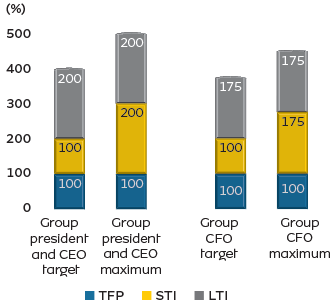
As illustrated above, the proportion of fixed to performance-based incentives varies between the group president and CEO and the group CFO. Both roles comprise a higher weighting on performance incentives 'risk pay' and less on fixed package. While the fixed package does not vary based on individual performance, the variable portion does. The group's integrated performance framework (IPF) guides the execution of business strategy by providing a framework through which the day-to-day and annual performance levels are set, cascaded and measured according to the business's strategic KPIs. The IPF outcomes are translated into incentive payments under the performance bonus plan.
Special arrangements
As a method to employ people in certain identified senior roles, under certain circumstances, employment and termination of employment negotiations result in cash payment arrangements in the form of lump sums. Where lump sums are mutually considered as sign-on, retention or termination payments, these are subject to the approval of the group president and CEO, or where applicable, the remuneration committee.
To attract key senior employees, it is sometimes necessary to compensate them for the loss of their equity in their previous companies. In 2017, the board approved that, upon joining the company, the following executives be granted a cash-settled on-boarding incentive to compensate them for the pre-tax amount of stock or equity they relinquished in terms of contractual agreements with their previous employers.
| Incentive grant price |
Incentive maturity date |
Number of units^ granted |
Value of incentive at grant date |
|||||||||||||
| Rob Shuter | R125,09 | 12/03/2020 | 327 214 | R40 931 199 | ||||||||||||
| Ralph Mupita | R113,10 | 28/10/2019 | 446 027 | R50 445 654 | ||||||||||||
| Jens Schulte-Bockum | R127,60 | 15/01/2020 | 64 423 | R8 220 375 | ||||||||||||
|
^ Units are the equivalent of an MTN Group share |
||||||||||||||||
Performance-based incentives
We provide different incentives to employees to reward performance on a short- and long-term basis:
Incentive category
STI schemes
LTI schemes
Purpose
To reward the achievement of set goals up to one year
To reward the achievement of set goals in the long run
Incentive plan
- December incentive plan (4% incentive plan).
- Performance bonus plan (bonus plan).
- Sales commission plan (commission scheme).
- Share appreciation rights scheme (SARS)1.
- Share rights plan (SRP)1.
- Performance share plan (PSP).
- Notional share option scheme (NSO).
- Employee share ownership plan (ESOP)2.
- 2016 MTN employee share ownership plan (ESOP)3.
1 Both SARS and SRP are active but no longer issuing new awards. They were substituted with the PSP.
2 Once-off award of 400 shares made in 2010 to lower level employees under the broad-based black employee equity (BBBEE) scheme.
3 Award of 516 shares made in 2017 to designated employees.
Short-term incentives
Annual performance bonus
With the exception of sales commission employees, all other employees participate in an annual performance-based bonus plan. The principles of the bonus plan are aligned primarily with the performance achievements of the company, and secondarily teams and individual priorities. This implies a bonus becomes payable once the board is satisfied that the minimum company performance levels have been achieved.
During the year, we reviewed our performance bonus policy. This review was necessitated as a response to the existing business challenges and associated people impact and industry practice. After benchmarking our existing model, the board approved the following changes effective for the 2018 financial year:
- Revision of the threshold performance for a bonus to be declared.
- Revision of associated performance metrics including the introduction of a non-financial metric.
- Simplification of the existing model for ease of understanding.
| Metric description | |||||||||||||
| Metric type | MTN subsidiaries | Weighting | Head Office | Weighting | |||||||||
| Financial | Revenue | 25% | Revenue | 20% | |||||||||
| Financial | EBITDA | 25% | EBITDA | 20% | |||||||||
| Financial | Group attributable earnings | 0% | Group attributable earnings | 20% | |||||||||
| Financial | Operating cash flow (cash generated from operations) | 25% | Operating cash flow (cash generated from operations) | 20% | |||||||||
| Non-financial | Competitive performance | 25% | Competitive performance | 20% | |||||||||
The process of determining the incentive award pools from which performance bonuses are paid is illustrated below:
Description of performance criteria
|
|
|
How a bonus is calculated
- Three elements are used as inputs to a bonus calculation, namely company performance (CP), team performance (TP) and employee performance (EP). Each element has a weighting (a), with all elements adding up to 100%.
- Targets for each element are set at the beginning of the performance cycle and measured at the end of the performance cycle where a corresponding 'nominal % (b)' is determined from a standard translation table.
- Company performance as a 'qualifier' for bonus declaration is first assessed for each operation.
- For each weighted element, there is a job level related on-target (c) and maximum (d) earning potential.
Upon assessment of company performance by the board, a bonus is either declared or not. If declared:
- Step 1: The weighting of each element (a) is multiplied by the achieved nominal (b) and the results of the three added together.
- Step 2: Then the sum of the three is multiplied by the on-target % (c) to derive the bonus percentage.
- Step 3: As a validation, a check is done against the maximum % for each job. If the calculated amount does not exceed the maximum, the final bonus percentage is multiplied by the annual incentive salary to arrive at the final bonus payment.
(CP + TP + EP) x on-target percentage
= bonus percentage
The bonus percentage (validated against
the minimum and maximum) x annual salary
= total bonus payable
= bonus percentage
The bonus percentage (validated against
the minimum and maximum) x annual salary
= total bonus payable
Case studies for three levels at group
For example, at the beginning of the year, the group's attributable earnings (GAE) target for calculating bonuses at the end of the year was set an illustrative R10 billion. For bonus purposes, a 90% minimum achievement of R9 billion was required and a maximum of R12 billion applicable. Using the following assumptions, the bonuses for the three employee levels: executive director, senior manager and employee level 2 will be as follows:
| Assumptions | Executive | Senior manager employee |
General staff level 2 (bonus declared) |
General staff level 2 (bonus not declared) |
|||||||||||||
| Annual salary |
R2 000 000 | R1 000 000 | R400 000 | R400 000 | |||||||||||||
| Bonus elements | |||||||||||||||||
| Company1 | 100% (50% weighting) |
100% (20% weighting) |
Not applicable | Not applicable | |||||||||||||
| Team2 | 75%2a (50% weighting) |
100%2b (50% weighting) |
100%2b (50% weighting) |
100%2b (50% weighting) |
|||||||||||||
| Employee3 | Not applicable | 150%3a (30% weighting) |
133%3b (50% weighting) |
133%3b (50% weighting) |
|||||||||||||
| On-target bonus (%) |
80% | 20% | 9% | 4,5% | |||||||||||||
| Maximum bonus (%) |
160% | 30% | 12% | 6% | |||||||||||||
| Calculation formula | (100% x 50%) plus (75% x 50%) plus zero equals 87,5% |
(100% x 20%) plus (100% x 50%) plus (150% x 30%) equals 115% |
Zero
plus (100% x 50%) plus (133% x 50%) equals 66,5% |
Zero
plus
(100% x 50%) plus (133% x 50%) equals 66,5% |
|||||||||||||
| Final bonus (%)4 | 87,5% x 80% equals 70% |
115% x 20% equals 23% |
66,5% x 9% equals 6% |
66,5% x 4,5% equals 3% |
|||||||||||||
| Final bonus payable |
R1 400 000 | R230 000 | R24 000 | R12 000 |
|
1 It is assumed that the company performance was achieved 100%. 2 It is assumed that the team performance was achieved as follows: 2a 75% for executive. 2b 100% for senior management and general staff level 2. 3 It is assumed that employee performance was as follows: 3a 150% for senior management. 3b 133% for general staff level 2. 4 On-target bonus is respectively: - 80% for executive. - 20% for senior management. - 9% for general staff where a bonus is declared. - 4,5% for general staff where a bonus is not declared. |
Executive bonus parameters for 2017
Given the significant recent changes to our executive team, here we provide the executive bonus parameters governing the bonus plan for 2017:
| Designation | Company performance |
Team performance |
Minimum bonus |
On target |
Maximum bonus |
||||||||||||||||
| Group president and CEO | 70% | 30% | 0% | 100% | 200% | ||||||||||||||||
| Group CFO | 70% | 30% | 0% | 100% | 175% | ||||||||||||||||
| Group chief operating officer | 50% | 50% | 0% | 100% | 175% | ||||||||||||||||
| Vice president: digital services, data analytics and business development | 50% | 50% | 0% | 100% | 160% | ||||||||||||||||
| Group chief human resources officer | 50% | 50% | 0% | 70% | 140% | ||||||||||||||||
| Group chief legal counsel | 50% | 50% | 0% | 70% | 140% | ||||||||||||||||
| Group chief regulatory and corporate affairs officer | 50% | 50% | 0% | 70% | 140% | ||||||||||||||||
| Vice president for SEAGHA | 30%/30% Group/region | 40% | 0% | 70% | 140% | ||||||||||||||||
| Vice president for WECA | 30%/30% Group/region | 40% | 0% | 70% | 140% | ||||||||||||||||
| Vice president for MENA | 30%/30% Group/region | 40% | 0% | 70% | 140% | ||||||||||||||||
| CEO: MTN South Africa | 30%/30% Group/opco | 40% | 0% | 70% | 140% | ||||||||||||||||
| CEO: MTN Nigeria | 30%/30% Group/opco | 40% | 0% | 70% | 140% |
For 2017, the executive directors' bonuses were calculated in line with the approved bonus principles. Full actual amounts of the bonuses paid can be found below.
General staff incentive calculations
For each financial period, two computations would apply for our lower level employees:
- Computation if the board declares bonuses based on achievement of minimum company performance levels being met.
- Computations if the board does not declare bonuses, i.e. minimum company performance levels are not met.
These three scenarios are summarised as follows:
| Description | Minimum 4% payment1 | Requirements if a bonus is declared by the board | Requirements if a bonus is not declared by the board | |||||||||||||
| Individual performance applies | Yes, an individual minimum performance score is required | Yes, an individual minimum performance score is required | Yes, an individual minimum performance score is required | |||||||||||||
| Earning range as a % of applicable annual salary | Exactly 4% | From 0% to 12% | From 0% to 6% | |||||||||||||
| Percentage payable at target achievement | Not applicable | 9% | 4,5% |
1 The 4% of annual remuneration payment in December remained a key vehicle for incentivising our general staff at employee levels 1 and 2. In accordance with the approved rules:
- This payment is conditional on minimum individual performance set by the company and on the basis that the employee is still in the employment of the company at payment date.
- All computations are based on the individual's previous year's (i.e. 2016) earnings and IPF scores.
MTN operations' bonus declarations
In line with the performance bonus rules, bonuses become payable within an operation once the committee is satisfied that the minimum performance thresholds have been achieved. For 2017, MTN Group Management Services (Head Office) employees received a bonus. A summary of the bonuses declared to the MTN Group operations is as follows:
| Bonus declared | Bonus declared | ||||||||||
| 2017 | 2016 | 2017 | 2016 | ||||||||
| Botswana | Yes | No | Afghanistan | No | No | ||||||
| South Africa | Yes | No | Congo-Brazzaville | No | No | ||||||
| Nigeria | Yes | No | Rwanda | Yes | No | ||||||
| Ghana | Yes | Yes | Zambia | Yes | No | ||||||
| Cameroon | No | No | Liberia | No | No | ||||||
| Ivory Coast | Yes | No | Guinea-Conakry | No | No | ||||||
| Uganda | Yes | No | Cyprus | Yes | Yes | ||||||
| Syria | Yes | Yes | South Sudan | Yes | No | ||||||
| Sudan | Yes | Yes | Iran | Yes | Yes | ||||||
| Benin | No | No | Swaziland | Yes | Yes | ||||||
| Yemen | No | Yes | Guinea-Bissau | Yes | No | ||||||
Long-term incentive (LTI) schemes
LTIs to managerial and senior employees are aimed at aligning their contributions to shareholders' expectations by sharing in the long-term growth of the company. Due to the fact that our operations are spread across 22 African and Middle Eastern countries, it is not always feasible to issue MTN stock to all employees as we are only listed on the Johannesburg Stock Exchange. For this reason, the company operates a combination of equity and cash-settled schemes.
The general rule is that participants are allocated shares, options, or rights equivalent to a fraction of their annual salary. Depending on the performance of the company measured using various indicators, participants proportionately either receive cash, equity or a combination of both. Although the eligibility of participants is defined in the rules of the schemes, MTN reserves the right to exclude participation by certain employees by virtue of their employment status, e.g. disciplinary, suspension, and dismissal.
The group has implemented the following schemes:
- Share appreciation rights scheme (SARS) and share rights plan (SRP).
- Objective: To promote the achievement of MTN group's strategic objectives measured using the company's growth in share price. Participating employees share in the appreciation of the company's share price between the grant and vesting dates.
| Eligible participants |
Date implemented |
Performance conditions |
Last vesting date |
Expiry period | |||||||||||||
| All employees at junior management level and above | 2006 – SARS 2008 – SRP |
Share price based |
2013 2015 |
2018 2020 |
Both the SARS and SRP were fully vested as at 2017 and are exercisable. Refer to  for the full reconciliation of 2017 trading. No further grants are being made under the SARS and SRP.
Performance share plan (PSP)
The PSP scheme is the current active and allocating plan, and is summarised as follows:
Objective: To promote the achievement of MTN Group's strategic objectives measured using the company's growth in share price and cash flow. Participating employees share in the company's achievement of the set financial indicators over three years.
| Eligible participants | Date implemented |
Performance conditions |
Last vesting date |
Expiry period | ||||||||||||||||
| All employees at junior management level and above | Not applicable | Total shareholder return (TSR) Adjusted free cash flow (AFCF) | 2020 | Not applicable |
Details about the PSP
- Share awards are at the discretion of the MTN Group board and the operating entities.
- Participation is limited to managerial employees and those in more senior positions only.
- Performance is measured using TSR and AFCF. An additional service element is applicable for non-executive participating employees.
- Weightings are attached to each condition based on the seniority of the participant.
- The scheme has a three-year vesting period. Once the shares are vested and the board is satisfied with the achievement of the performance conditions, participating employees receive either shares or the cash equivalent if the respective employee instructs the company to dispose of their shares on the employee's behalf.
2017 LTI changes
As part of an ongoing review process, we reviewed the performance metrics used to assess the performance of the PSP scheme. The outcome of this review was approved by the board for implementation effective for the 2017 share allocation. A summary of these changes is as follows:
| Current weightings | New metric weightings | ||||||||||||||
| Managerial | Managerial | ||||||||||||||
| Performance measure | Staff | Executives | Staff | Executives | |||||||||||
| TSR – JSE Top 25 Index |
37,5% | 50% | |||||||||||||
| TSR – MSCI EM Index1 |
25% | 25% | |||||||||||||
| AFCF | 37,5% | 50% | |||||||||||||
| Cumulative operating free cash flow (COFCF)2 |
25% | ||||||||||||||
| Return on average capital employed (ROACE) |
25% | ||||||||||||||
| Service/retention elements3 | 25% | 0% | 25% | ||||||||||||
1 MCSI Emerging Markets telecoms index measured on common currency, i.e. ZAR.
2 COFCF measured on a constant currency basis at budgeted numbers.
3 Approved for the December 2017 allocation only, to be reviewed on an annual basis.
Clawback and malus
Furthermore, the board approved the implementation of clawback and malus provisions effective for the December 2017 allocation. Clawback and malus apply where material misstatements of financial results or other calculation errors resulting in overpayment of incentives are recovered from the employee, or corrected in the case of such errors. Thus the 2017 PSP allocations were made inclusive of the clawback and malus provisions which will become enforceable upon approval by the MTN shareholders at the annual general meeting.
Performance of the scheme
A summary of the allocation is as follows:
| Condition achieved | |||||||||||||
| Grant date | Vesting date | Adjusted free cash flow | Total shareholder return | ||||||||||
| 29/06/16^ | 29/12/18 | – | – | ||||||||||
| 28/12/16 | 28/12/19 | – | – | ||||||||||
| 18/12/17^^ | 18/12/20 | – | – | ||||||||||
^ This allocation was in respect of December 2015 and had been deferred as the company was trading under cautionary.
^^ Allocation made under new revisions.
Employee share ownership plan (ESOP)
During 2010, MTN approved the allocation of shares to its lower-level employees under the company’s broad-based employee share scheme – employee share ownership plan (ESOP).
The scheme was intended to incentivise the designated employees and to identify them more closely with the activities of the company with the aim of promoting their continued growth by giving them shares. Participating employees under the ESOP scheme had to retain ownership of their shares for a period of five years until December 2015, when the scheme matured.
During 2016, the board approved a second allocation of shares to designated employees under the 2016 MTN employee share ownership plan (2016 ESOP). This scheme is managed under trust. The first allocation of awards was made to qualifying employees on 1 December 2017.
Further details of both schemes are as follows:
| Number of participants as at issue date | Number of shares allocated |
Plan vesting date |
Number of shares traded (as at 31 December 2017 |
Number of shares outstanding (as at 31 December 2017)† |
|||||||||||||||||
| 3 461 | 1 384 400 | 1 December 2015 | 1 December 2015 | 391 252 | |||||||||||||||||
| 3 920 | 2 022 720 | 1 December 2018 | 0 | 666 156 | |||||||||||||||||
| 1 December 2019 | 0 | 666 156 | |||||||||||||||||||
| 1 December 2020 | 0 | 666 156 |
† Excluding forfeited shares.
For the 2010 ESOP award, as at 31 December 2017, from a total of 3 461 participants:
- 1 810 allocated employees had left the employment of the company for various reasons, voluntary and involuntary.
- 1 651 were still in the employ of the company. Thus the number of retained employees represents a retention rate of 48%.
No shares had vested as at 31 December 2017 under the 2016 ESOP.
A summary of all previous allocations and the vesting dates made under the long-term incentive scheme is presented below:
Equity share schemes vesting schedule
| Vesting timelines per anniversary (cumulative) | ||||||||||||||||||||||||||||||||
| Plan type |
Issue period date | Year 0 | > Year 1 | > Year 2 | > Year 3 | > Year 4 | > Year 5 | > Year 10 | ||||||||||||||||||||||||
| SARS | 19 Mar 2008 | ✔ | ●●●● | ♦●●● | ♦♦●● | ♦♦*● | ♦♦** | ✗ | ||||||||||||||||||||||||
| 1 Sept 2008 | ✔ | ●●●● | ♦●●● | ♦♦●● | ♦♦*● | ♦♦** | ✗ | |||||||||||||||||||||||||
| 28 Jun 2010^ | ✔ | ●●●● | ♦●●● | ♦♦●● | ♦♦*● | ♦♦** | ✗ | |||||||||||||||||||||||||
| PSPs | 29 Jun 2011^^ | ✔ | ●●●● | ●●●● | ●●➢ | ♦♦** | ||||||||||||||||||||||||||
| 29 Jun 2011 | ✔ | ●●●● | ●●●● | ●●●●➢ | ♦♦** | |||||||||||||||||||||||||||
| 29 Dec 2011 | ✔ | ●●●● | ●●●● | ●●●●➢ | ♦♦** | |||||||||||||||||||||||||||
| 28 Dec 2012 | ✔ | ●●●● | ●●●● | ●●●●➢ | ♦♦** | |||||||||||||||||||||||||||
| 20 Dec 2013 | ✔ | ●●●● | ●●●● | ●●●●➢ | ♦♦** | |||||||||||||||||||||||||||
| 19 Dec 2014 | ✔ | ●●●● | ●●●● | ●●●●➢ | ♦♦** | |||||||||||||||||||||||||||
| 19 Dec 2014 | ✔ | ●●●● | ●●●● | ●●●●➢ | ♦♦** | |||||||||||||||||||||||||||
| 19 Dec 2014 | ✔ | ●●●● | ●●●● | ●●●●➢ | ♦♦** | |||||||||||||||||||||||||||
| 29 Jun 2016^ | ✔ | ●●●● | ●●●● | ●●➢ | ♦♦** | |||||||||||||||||||||||||||
| 28 Dec 2016 | ✔ | ●●●● | ●●●● | ●●●●➢ | ♦♦** | |||||||||||||||||||||||||||
| 9 Mar 2017 | ✔ | ●●●● | ●●●● | ●●●●➢ | ♦♦** | |||||||||||||||||||||||||||
| 29 Sept 2017 | ✔ | ●●●● | ●●●● | ●●●●➢ | ♦♦** | |||||||||||||||||||||||||||
| 18 Dec 2017 | ✔ | ●●●● | ●●●● | ●●●●➢ | ♦♦** | |||||||||||||||||||||||||||
| ^ | This offer includes an allocation with one-year accelerated vesting. |
| ^^ | This offer was accelerated from 36 months to 30 months. |
| Key: |
| ✓ Allocation date ♦ 20% tranche vested (cumulative) * 30% tranche vested (cumulative) ➢ Performance conditions evaluation ● Non-vested portion of award ✗ Expiry |
MTN non-equity schemes for employees in non-listed operations outside South Africa
MTN offers non-South Africa-based employees participation in the group’s notional share option (NSO) scheme. This scheme enhances MTN’s commitment to the ‘One Group, One MTN’ philosophy.
Qualifying employees own options and also participate in the growth of the group and its operations, as applicable. The main objective of the NSO scheme is to encourage an alignment between the individual interests of senior employees and the long-term success of the group. Thus, the scheme’s design rewards employees for the value gain derived from the NSO price per share appreciation between the allocation and vesting dates.
Non-executive directors’ remuneration
The R&HR committee is responsible for advising on the remuneration of non-executive directors (NEDs), including reviewing remuneration recommendations as put forward by executive management in consultation with external remuneration consultants. The committee also recommends remuneration for approval by the board and shareholders. The remuneration for NEDs is considered annually and is determined in light of market practice and with reference to the time, commitment and responsibilities associated with the roles.
The MTN Group’s non-executive directors receive an annual retainer and a meeting attendance fee. They do not participate in any type of incentive scheme nor do they receive any employee-related benefits.
In 2017, the board did not consider an increase to the NED fees. However, a benchmark exercise conducted by management highlighted a need to review and align the fees paid to our chairman of the board based on the peer benchmark criteria. All other committee members were granted an inflation-linked increase. Thus, the fee structure for 2018 is as follows:
| Annual retainer fee |
Meeting attendance fee |
Annual retainer fee |
Meeting attendance fee |
||||||||||||||||
| 2017 | 2017 | 2018 | 2018 | ||||||||||||||||
| MTN GROUP BOARD | |||||||||||||||||||
| Chairman | R2 518 081 | R139 893 | R2 886 671 | R160 370 | |||||||||||||||
| Member | R212 492 | R53 123 | R225 242 | R56 310 | |||||||||||||||
| International member | €76 928 | €7 693 | €78 082 | €7 808 | |||||||||||||||
| Special assignments or projects (per day) | |||||||||||||||||||
| Local non-executive director | – | R22 639 | – | R23 997 | |||||||||||||||
| International non-executive director | – | €3 373 | – | €3 424 | |||||||||||||||
| Ad hoc work performed by non-executive directors for special projects (per hour) | – | R3 985 | – | R4 224 | |||||||||||||||
| Audit committee | |||||||||||||||||||
| Chairman | R112 901 | R34 828 | R119 675 | R36 918 | |||||||||||||||
| Member | R61 681 | R23 997 | R65 382 | R25 437 | |||||||||||||||
| Remuneration and human resources committee | |||||||||||||||||||
| Local chairman | R84 303 | R31 757 | R89 361 | R33 662 | |||||||||||||||
| International chairman | €5 625 | €3 590 | €5 709 | €3 644 | |||||||||||||||
| Local member | R49 401 | R23 289 | R52 365 | R24 686 | |||||||||||||||
| International member | €3 297 | €3 297 | €3 346 | €3 346 | |||||||||||||||
| Risk management, compliance and corporate governance committee | |||||||||||||||||||
| Chairman | R84 303 | R31 757 | R89 361 | R33 662 | |||||||||||||||
| Member | R49 401 | R23 289 | R52 365 | R24 686 | |||||||||||||||
| International member | €3 297 | €3 297 | €3 346 | €3 346 | |||||||||||||||
| Social and ethics committee | |||||||||||||||||||
| Chairman | R84 303 | R31 757 | R89 361 | R33 662 | |||||||||||||||
| Member | R49 401 | R23 289 | R52 365 | R24 686 | |||||||||||||||
| MTN Group Share Trust (trustees) | |||||||||||||||||||
| Chairman | R74 929 | R28 226 | R79 425 | R29 920 | |||||||||||||||
| Member | R32 943 | R15 530 | R34 920 | R16 462 | |||||||||||||||
| Sourcing committee | |||||||||||||||||||
| Chairman | R74 929 | R28 226 | R79 425 | R29 920 | |||||||||||||||
| Member | R43 783 | R20 641 | R46 410 | R21 879 |
Employment contracts
Group president and CEO (executive director)
The appointment of the group president and CEO, Rob Shuter, was effective from 1 July 2017; however, he started working on 13 March 2017. His appointment is for a four-year fixed duration to 12 March 2021. He has a notice period of six months and a restraint of trade of 12 months.
Chief financial officer (executive director)
The appointment of the new CFO, Ralph Mupita, was effective 3 April 2017 and is of no fixed duration. He has a notice period of six months and a restraint of trade of 12 months.
Prescribed officers
Other prescribed officers of the company are employed on a full-time and permanent basis with no fixed termination date applicable, with the exception of the group COO, Jens Schulte-Bockum, who is employed for a limited duration period terminating on 15 January 2021. His employment commenced on 16 January 2017.
Restraint of trade and notice period
All appointments since 2014 of both executive directors and prescribed officers have a six-month notice period. In total, including a six-month restraint period, this means that executives and prescribed officers have a total of 12 months, a period management believes is an adequate measure to protect the company’s information.
Directors’ emoluments
Directors’ and prescribed officers’ emoluments and related payments in the tables presented here
have been audited. Comparative figures for 2016 are available in the . Full details on directors’
and prescribed officers’ emoluments and equity compensation benefits for executive directors,
prescribed officers, the group secretary of the MTN Group and directors of major subsidiaries in
respect of the share appreciation rights and share rights schemes and the performance share plan
are in the . This also includes shareholdings and dealings in MTN Group ordinary shares and
MTN Zakhele Futhi shares by MTN Group directors, prescribed officers, the group secretary and
directors and company secretaries of major subsidiaries.
Emoluments
Non-executive directors
| Date appointed |
Retainer# R000 |
Attendance# R000 |
Special board R000 |
Strategy session R000 |
Ad hoc work R000 |
Total R000 |
|||||||||||||||||||||||
| PF Nhleko^ | 28/05/2013 | 2 694 | 1 042 | 12 | 280 | – | 4 028 | ||||||||||||||||||||||
| PB Hanratty∞ | 01/08/2016 | 986 | 457 | 11 | 236 | 65 | 1 755 | ||||||||||||||||||||||
| A Harper∞ | 01/01/2010 | 932 | 497 | 11 | 222 | 4 | 1 666 | ||||||||||||||||||||||
| KP Kalyan | 13/06/2006 | 449 | 433 | 12 | 106 | – | 1 000 | ||||||||||||||||||||||
| S Kheradpir∞ | 08/07/2015 | 961 | 306 | 7 | 228 | 19 | 1 521 | ||||||||||||||||||||||
| NP Mageza | 01/01/2010 | 408 | 577 | – | – | – | 985 | ||||||||||||||||||||||
| MLD Marole | 01/01/2010 | 370 | 597 | 12 | 106 | – | 1 085 | ||||||||||||||||||||||
| AT Mikati∞† | 18/07/2006 | 823 | 387 | 11 | 221 | 62 | 1 504 | ||||||||||||||||||||||
| SP Miller∞ | 01/08/2016 | 855 | 352 | 11 | 229 | 27 | 1 474 | ||||||||||||||||||||||
| KC Ramon@ | 01/06/2014 | 385 | 489 | 12 | 106 | 44 | 1 036 | ||||||||||||||||||||||
| NL Sowazi | 01/08/2016 | 324 | 359 | 12 | 106 | – | 801 | ||||||||||||||||||||||
| AF van Biljon‡ | 01/11/2002 | 212 | 226 | 12 | 106 | 60 | 616 | ||||||||||||||||||||||
| J van Rooyen | 18/07/2006 | 397 | 661 | 12 | 106 | 52 | 1 228 | ||||||||||||||||||||||
| Total | 9 796 | 6 383 | 135 | 2 052 | 333 | 18 699 |
| All payments in rand, unless specified. | |
| ∞ | Fees have been paid in euro. |
| † | Fees are paid to M1 Limited. |
| @ | Retainer and attendance fees include fees for board and committee representation and meetings. |
| # | Fees paid to Anglogold Ashanti Limited. |
| ^ | Fees paid to Captrust Investments Proprietary Limited. |
| ‡ | Resigned on 31 December 2017. |
Executive directors
| Date appointed |
Salaries R000 |
Post-employment benefits R000 |
Other@ benefits R000 |
Bonuses R000 |
Sub-total R000 |
Share gains∞ R000 |
Total R000 |
||||||||||||||||||||||||||
| PF Nhleko^^†^^^ | 09/11/2015 | 19 950 | – | – | 22 477 | 42 427 | – | 42 427 | |||||||||||||||||||||||||
| R Shuterˆ | 13/03/2017 | 11 528 | 1 225 | 10 581 | 17 122 | 40 456 | – | 40 456 | |||||||||||||||||||||||||
| R Mupita | 03/04/2017 | 5 944 | 673 | 384 | 10 672 | 17 673 | – | 17 673 | |||||||||||||||||||||||||
| Total | 37 422 | 1 898 | 10 965 | 50 271 | 100 556 | – | 100 556 |
| ∞ | Pre-tax gains on share-based payments. |
| ^^ | Executive director until 12/03/2017. |
| ^^^ | Fees paid to Captrust Investments Proprietary Limited. |
| ˆ | Other benefits include an amount paid in lieu of forfeited benefits from previous employer. |
| † | Contractual service fees and bonus in accordance with agreement between MTN and Captrust Investments Proprietary Limited. |
| @ | Includes medical aid and unemployment insurance fund. |
Prescribed officers
| Salaries R000 |
Post- employment benefits R000 |
Other# benefits R000 |
Bonuses R000 |
Sub-total R000 |
Share gains∞ R000 |
Total R000 |
|||||||||||||||||||||||
| E Asante1 | 1 451 | 113 | 329 | 2 744 | 4 637 | 4 637 | |||||||||||||||||||||||
| J Desai2 | 526 | – | – | – | 526 | – | 526 | ||||||||||||||||||||||
| G Engling3 | 1 092 | 124 | 294 | 1 200 | 2 710 | – | 2 710 | ||||||||||||||||||||||
| M Fleischer | 6 706 | 789 | 478 | 6 204 | 14 177 | – | 14 177 | ||||||||||||||||||||||
| I Jaroudi^ | 10 481 | – | 1 517 | 6 686 | 18 684 | – | 18 684 | ||||||||||||||||||||||
| G Motsa4@ | 6 384 | 722 | 5 294 | 6 409 | 18 809 | – | 18 809 | ||||||||||||||||||||||
| F Moolman | 9 032 | 448 | 518 | 7 604 | 17 602 | 17 602 | |||||||||||||||||||||||
| P Norman^ | 5 232 | 616 | 3 920 | 5 090 | 14 858 | – | 14 858 | ||||||||||||||||||||||
| M Nyati5 | 765 | 87 | 694 | - | 1 546 | – | 1 546 | ||||||||||||||||||||||
| F Sekha6 | 3 440 | 389 | 183 | 1 884 | 5 896 | – | 5 896 | ||||||||||||||||||||||
| J Schulte-Bockum7 | 8 218 | 876 | 303 | 10 492 | 19 889 | – | 19 889 | ||||||||||||||||||||||
| K Toriola | 6 236 | 72 | 1 178 | 3 781 | 11 267 | – | 11 267 | ||||||||||||||||||||||
| S van Coller | 7 723 | 874 | 612 | 10 276 | 19 485 | – | 19 485 | ||||||||||||||||||||||
| Total | 67 286 | 5 110 | 15 320 | 62 370 | 150 086 | – | 150 086 |
| ^ | Other benefits include compensation in lieu of employment agreement amendments related to revised notice period and restraint of trade. |
| @ | Other benefits include a retention payment in lieu of forfeiture of performance bonus from previous employer. Payment is to be spread over three years. |
| 1 | Appointed on 1 October 2017. |
| 2 | Ceased to be a prescribed officer on 16 January 2017. |
| 3 | Ceased to be a prescribed officer on 3 April 2017. |
| 4 | Appointed on 1 January 2017. |
| 5 | Until 10 March 2017. |
| 6 | Appointed on 1 June 2017. |
| 7 | Appointed on 16 January 2017. |
| 8 | Includes medical aid and unemployment insurance fund. |