Our material issues in 2015
Determining materiality
Material issues for the purposes of the 2015 integrated report are those issues which had a financial
and/or reputational impact on MTN in the year and had the potential to disrupt the delivery of our
strategy. When identifying the matters we considered material, we took into account the most pressing
themes of our quarterly reporting meetings (attended by the chief executives of the 22 operations) as
well as those matters which received the most management and board attention in the year.
Building on the 2014 process, we identified issues in both the external and internal operating environment
and refined those to the factors which influenced MTN’s performance and reputation in the year.
We considered the key concerns of stakeholders , as well as the risks identified through our risk
management process ( 24). These factors were then debated at workshops at which senior managers
of a broad range of MTN departments participated.
While we discussed matters considered material in all operations, we narrowed down the Group’s
material issues in 2015 to those which impacted the top nine operations
( IFC) and so, ultimately the
Group†. The executive committee and the board then endorsed these as the material issues in 2015.
† In this section we do, however, discuss a few issues in smaller markets, listing them by name, given their potential to spill over into other markets.
The material issues of 2015 cut across the Group’s top risks, which are monitored by management.
We use the icon  throughout this report when we refer to these material issues.
| 1 |
|
2 |
|
3 |
|
4 |
|
5 |
| Ensuring
sound
governance,
ethics, legal
compliance,
and
overcoming
regulatory
challenges |
|
Political and
economic
developments
and their
impact on
our markets |
|
Increased
competition
and changes
in the
telecoms
landscape |
|
Operational
execution,
management
changes in
key markets
and employee
engagement |
|
Delivering a
consistent
and distinct
customer
experience
through all
MTN touch
points |
| 6 |
|
Managing stakeholder relationship and the Group’s reputation |
| 1} |
Ensuring sound governance, ethics,
legal compliance and overcoming
regulatory challenges |
|
|
Across our markets, regulatory pressure continued to increase. This included greater customer SIM card
registration requirements. MTN Nigeria disconnected 6,7 million subscribers in 2015. In November and
December 2015 MTN Uganda disconnected 3,7 million subscribers who did not fully comply with the
subscriber registration requirements.
Impact on MTN in 2015
Subscriber net additions for the year were impacted
negatively, eroding the market share of MTN Nigeria
and MTN Uganda. |
|
Action taken by MTN
We worked to improve our relations with regulators, and all
stakeholders. We focused on enhancing our regulatory
compliance processes, including greater use of biometrics
to improve subscriber registration. In Nigeria, we set up
additional registration points and invested approximately
US$20 million in new systems and hardware in the year. |
|
During October 2015, the Nigerian regulator imposed a N1,040 trillion fine on MTN Nigeria, subsequently
reduced to N780 billion (equivalent to approximately US$3,9 billion using the exchange rate prevailing at
the time). This related to the late disconnection of the 5,1 million subscribers whose registration documents
were considered incomplete. The factors related to the disconnection of these Nigerian subscribers and the
fine provided an opportunity to review the implementation of our policies and procedures.
Impact on MTN in 2015
The imposed fine eroded investor confidence in
MTN Nigeria and the Group as a whole, and negatively
impacted the reputation of MTN across our stakeholder
groups. Between 26 October and 31 December 2015,
MTN Group’s market capitalisation declined by 20%.
The Group CEO, MTN Nigeria’s CEO and MTN Nigeria’s
regulatory head left the Group in 2015.
MTN Nigeria recorded a R9 287 million provision for
the fine at the end of the reporting period, negatively
impacting reported EBITDA by 13,6%** and HEPS by
402 cents. Management has applied its judgement in
determining the provision in accordance with IFRS. |
|
Action taken by MTN
We continue to engage with the Nigerian authorities to
ensure an amicable resolution in the best interests of the
Company, its stakeholders and the Nigerian authorities.
On
24 February 2016, MTN Nigeria made an agreed,
without prejudice, good faith payment of 50 billion naira
(US$250 million) to the Federal Government of Nigeria on
the basis that this will be applied towards a settlement,
when one is eventually, hopefully arrived at. MTN also
agreed to withdraw the matter from the Federal High
Court in Lagos. In early December we announced a
change in the Group’s operating structure, recognising
the need for stronger Group oversight over the
operations. The new structure, effective in 2016,
combined with new leadership, endeavours to provide
that ( 10). The Group appointed PF Nhleko ( 44)
as executive chairman in a temporary capacity upon
the resignation of the Group CEO with a mandate to
resolve the Nigerian fine issue and appoint a new CEO.
In addition the Group has also implemented a new
regulatory and compliance structure ( 54). We worked
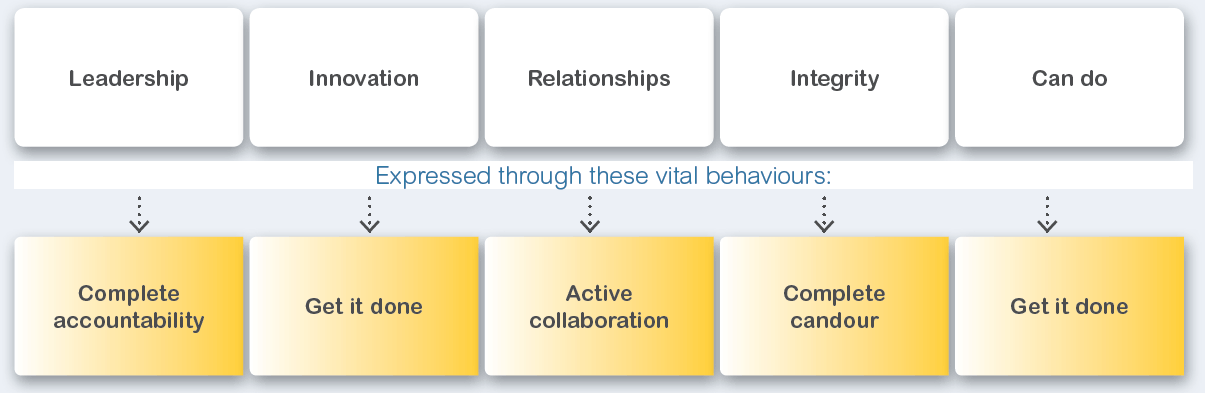
to re-inforce the Group culture and values ( 13) which
encompass complete accountability and candour, as
well as the escalation of material issues to MTN Group
and Group board level. |
|
The Nigerian regulator’s 2013 ruling declaring MTN Nigeria a “dominant operator” continued to impact
MTN Nigeria’s commercial success.
Impact on MTN in 2015
This continued to limit MTN’s commercial success,
hampering our ability to be competitive in Nigeria in
2015 ( 34). In October 2015, the regulator suspended
regulatory services to MTN Nigeria. Under this
suspension the regulator could use its discretion on
services provided to MTN Nigeria until certain tariff plans
and promotions were removed from the market. The
regulator has subsequently, in March 2016, re-instated
services to MTN Nigeri |
|
Action taken by MTN
We continued to engage with regulatory authorities to
determine the parameters of the “dominant operator”
ruling and to ensure that it does not further impact
growth of MTN, which has invested significantly in
the Nigerian network over the past 15 years. |
|
In some markets, requirements for foreign companies to broaden local ownership of their subsidiaries
through listings on local stock exchanges remained a feature.
Impact on MTN in 2015
Any listing of a large MTN operation could lead to a
dilution of MTN earnings. However, this needs to be
weighed up against the benefits that greater local
representation could bring. |
|
Action taken by MTN
We continued to evaluate opportunities and appropriate
mechanisms to ensure broader local ownership,
including in key markets such as Nigeria. However,
market conditions and the operating environment need
to be conducive before any listing is pursued.
MTN Ghana must have a minimum of 35% Ghanaian
ownership in place by January 2017. This is a
requirement of it winning the auction for a 4G/LTE
licence. MTN South Africa is committed to supporting
transformation in the country by, among others,
partnering with black economic empowerment entities
in our sourcing activities. |
|
Media reports questioned MTN’s compliance with new international tax rules issued by the Organisation for
Economic Co-operation and Development in October. These rules seek to change the tax system that is seen
to allow multinationals to reduce their effective tax rate in a jurisdiction without corresponding reduction in
value-creating economic activities.
Impact on MTN in 2015
This has caused the Group some reputational damage
and increased regulatory scrutiny, influenced by media
interpretation. |
|
Action taken by MTN
We conducted an independent assessment and are
confident of our compliance with these tax legislations.
In 2015, we made further improvements in our tax
disclosure, providing stakeholders with more
transparency. A full tax report is available on  . |
|
Our values, which define our culture
|
| 2} |
Political and economic developments
and their impact on our markets |
|
|
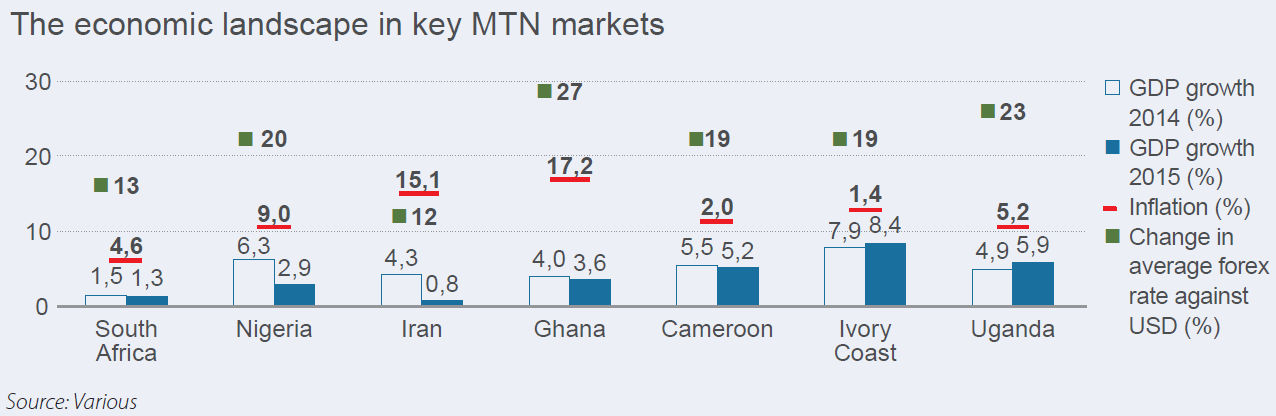
The global economy remained weak, with slower demand for commodities and an oil surplus hurting the
economies and currencies of commodity and oil exporters, including South Africa, Nigeria, Iran, Sudan and
Ghana. Currencies across our footprint depreciated in the year. In some markets, authorities introduced more
taxes to make up for declining oil and commodity income . (For the economic landscape in key
MTN markets see graphic on 15.)
Impact on MTN in 2015
The decline in disposable incomes and consumer
expenditure impacted growth in MTN revenue and
margins. Foreign exchange market volatility made
MTN’s US dollar-denominated debt more expensive and
had a negative impact on the translation of reported
results ( 30). It increased the cost of capital equipment,
and also affected our ability to remit dividends to the
Group. |
|
Action taken by MTN
We continued to prioritise prudent financial management,
and to endeavour to repatriate earnings from operations
while taking into account their capital structure as well as
local regulations. In addition, MTN continued to raise
funding in local currency where possible as a natural
hedge against moves in the US dollar. We also continued
to work hard to shift US-dollar capex and opex into local
currency.
We endeavoured to persuade authorities that increased
taxes are a short-term remedy, and could harm the
continued growth of the sector which is a major
contributor to the fiscus of many of these countries. |
|
Elections in Nigeria led to the peaceful handover of power to a new president. The sharp fall in oil revenues
put pressure on the naira and reduced the availability of hard currency.
Impact on MTN in 2015
The peaceful transition was good for the country, and our
business, although uncertainty over the extent of the
naira’s depreciation, along with currency restrictions,
led to difficulties in repatriating funds from Nigeria,
and made it hard to make payments on US dollar-denominated
debt ( 30). |
|
Action taken by MTN
We engaged constructively with Nigerian authorities
in support of the new government’s national priorities
relating to the telecommunications industry. We
continued to engage with the Central Bank of Nigeria
regarding the availability of hard currency and explored,
and are still exploring, alternatives to solve this issue. |
|
In July, Iran reached a landmark nuclear deal with six world powers, opening the way for a phased lifting
of nuclear-related economic and financial sanctions from January 2016.
Impact on MTN in 2015
The deal should assist the economy broadly. It increased
the potential for MTN Group to repatriate dividends and
outstanding loan funding from our operation in Iran, with
due consideration to capital and forex requirements.
At year end, MTN held cash of R15 860 million in Iran
( 37). |
|
Action taken by MTN
We continued to participate in high-level engagements
with the relevant authorities regarding sanctions and the
repatriation of dividends and outstanding loan funding.
We also expanded our offerings, including the
establishment of an enterprise business unit in Iran. |
|
In December, the rand depreciated significantly against the US dollar.
Impact on MTN in 2015
This impacted MTN’s share price negatively. |
|
Action taken by MTN
MTN continued to monitor the fluctuation in the rand
and its impact on the economy, with appropriate actions
taken to minimise the impact on the Group. |
|
The civil war in Syria escalated and unrest continued in parts of Nigeria, Sudan, Cameroon, Yemen and
Afghanistan, among others.
Impact on MTN in 2015
This continued to impact MTN’s financial and operating
metrics in these markets. |
|
Action taken by MTN
Without compromising the safety of our employees,
we continued to offer telecoms services in challenging
environments, even amid conflict, with careful
contingency planning and business continuity
management ( 57). |
|
| 3} |
Increased competition and changes
in the telecoms landscape |
|
|
With increased pressure on consumer spending and the non-conventional players competing for a greater
share of the consumer wallet, traditional telecommunications players continued to cut their tariffs in an effort
to increase their market share. In many markets competitors cut their tariffs to below cost.
Impact on MTN in 2015
Voice tariffs declined by 25% across MTN’s operations
in the year (average price per minute in US dollar terms).
The Group’s effective data tariff (in US dollar terms)
declined by 45%. This put pressure on growth in revenue
and profitability in many markets. |
|
Action taken by MTN
To remain relevant to customers, as well as competitive,
we reduced tariffs. We pursued various other revenue-generating
opportunities to make up for revenue foregone as
a result of this. We continued work to diversify our earnings
through developing new opportunities in digital, enterprise
and financial services. Dedicated Group Consumer, Group
Digital Services and Group Enterprise divisions are now fully
functional to ensure that we are well positioned to participate
in the rapidly evolving industry and to effectively meet our
customers’ needs with regards to digital, financial and
enterprise services. We partnered with various content
providers and continued to focus on expanding our
e-commerce venture. During the year we appointed various
new specialists to drive these new initiatives. We invested a
total of R29 billion in capex ( 20, 42, 96 and 22). |
|
As the demand for data services increases so too does the need for additional spectrum. The biggest
challenge we faced was in the South African market, where additional spectrum is required for the rollout
of LTE services. 800MHz and 2,6GHz spectrum is currently not available to telecommunications operators.
In the year we secured additional spectrum to drive LTE/4G services in Nigeria and Ghana.
Impact on MTN in 2015
Spectrum shortages limit our ability to provide more
customers with broadband services and faster data
speeds, and so limit profitability.
As a short-term solution MTN has embarked on refarming
its existing spectrum in South Africa to provide
improved LTE services to customers although this is
more costly and caused disruptions in the network in
the year ( 32). |
|
Action taken by MTN
Additional spectrum is crucial to the long-term growth of
the operation. In an effort to better utilise available spectrum
MTN South Africa entered into a bilateral roaming
agreement with Telkom Limited, South Africa’s fixed-line
operator. However, this was blocked by the Competition
Commission. The regulator ICASA has issued an information
memorandum on auctioning 700MHz, 800MHz and 2,6GHz
spectrum, which we support. We are also working with
relevant authorities to shape South Africa’s broadband
policy. In Nigeria, MTN acquired Visafone. This, along with
the acquisition of a 4G/LTE licence and digital TV spectrum,
will provide us with access to sufficient spectrum to roll out
LTE services. In Ghana, in an auction process we bought a
15-year 4G/LTE licence in the 800MHz spectrum band
which enables us to offer 4G/LTE services. |
|
 |
| 4} |
Operational execution, management changes
in key markets and employee engagement |
|
|
As competition intensified in the year and the business continued to evolve towards more data-related
services, MTN faced lower than expected performance in parts of the business, particularly Nigeria.
However, actions taken to address poor operational performance in South Africa in 2014 bore fruit.
Impact on MTN in 2015
In Nigeria, growth in data revenue was constrained as a result of an
uncompetitive data network. MTN Nigeria data revenue
increased only 18,8%* in the year, limiting growth in
overall MTN Nigeria and MTN Group revenue. MTN South
Africa improved its operational performance, with
increases in revenue, supported by a number of
management changes – some in 2014 – as well as
increased capital expenditure with a key focus on
improving its 3G and LTE network. In South Africa, data
revenue increased 37% as a result of better quality 3G
and LTE networks ( 32). |
|
Action taken by MTN
To strengthen operational oversight, in December we
announced that we would re-implement our previous
reporting structure, with vice presidents for each of the
three regions, and the re-instatement of the Group chief
operating officer ( 10). In Nigeria, MTN made a number
of management changes to address the lower than
expected performance. This includes the creation of a
chief operations officer role. We increased capex in
South Africa by 92,9% to R10,9 billion, rolling out 966 2G,
1 593 co-located 3G and 3 148 co-located LTE sites. In
July 2015, we appointed a new MTN South Africa CEO.
More detail on operational performance can be found
on 32. |
|
In the year, members of the Communications Workers Union went on an extended strike in South Africa over
bonuses and salary adjustment policies.
Impact on MTN in 2015
The functioning of MTN South Africa’s call centres was
disrupted, affecting customer service. Employee morale
and Group reputation were adversely affected. However,
the result of the resolution of the industrial action was
ultimately good, with greater staff engagement and
recognition of trade unions. |
|
Action taken by MTN
We recognised that the prioritisation of the people and
culture agenda was required, and that performance
management needed to be more effective, and
employee development strengthened. Acknowledging
the need to ensure that talent management processes
evolve to support MTN’s core and new businesses,
we embarked on transforming our approach to hiring,
developing, leading and managing performance of
our people at all levels and cultivating a culture and
environment of innovation throughout the business
( 66). The Company has also taken a decision to
recognise the Communications Workers Union which will
enable MTN South Africa to define a process and to
ensure a constructive relationship going forward. |
|
| 5} |
Delivering a consistent and distinct customer
experience through all MTN touch points |
|
|
Customer experience was negatively affected by slow data network speeds in MTN Nigeria, and disruptions
in the network in South Africa, while upgrades were being made. The increase in the out-of-bundle data tariff
by MTN South Africa led to customer complaints of incorrect billing. Customer registration requirements in a
number of markets were considered an inconvenience by many subscribers. The subsequent disconnection
of unregistered subscribers (in Nigeria and Uganda in particular) also impacted customer experience.
Impact on MTN in 2015
Increased customer churn and greater use by customers
of multiple SIM cards affected growth in MTN’s revenues
and profitability. This also caused some damage to
MTN’s reputation. |
|
Action taken by MTN
We continued to work at improving the customer experience
at all touch points, improving communication with customers
through the introduction of notifications and alerts when they
incur data costs and once their data bundles are depleted.
We implemented an evolved operating structure to harness
opportunities in innovation, and to increase our focus to
ensure that our business grows and meets the needs of
customers. We continued to invest in rolling out infrastructure
and improving coverage across our markets, ensuring that
we provide quality and capacity to our customers ( 10).
In nine opcos, including Nigeria, we outsourced call centres
and introduced new systems to improve their performance. |
|
| 6} |
Managing stakeholder relationships and the
Group’s reputation |
|
|
In 2015, each of the events detailed in material issues 1 to 5 had an adverse impact on the reputation and the
stakeholders of the Company in one way or another. This was seen in various measures, including media
commentary, the Group’s share price, customer and employee feedback and action, as well as interactions
with governments and regulators.
Impact on MTN in 2015
The perception of MTN as a company was impacted
by various reports in the media concerning some of the
challenges faced by management during the year.
This had an adverse effect on the Group’s reputation
and share price.
MTN’s stakeholder universe includes Group and
operations shareholders, governments, regulators,
customers, communities and civil societies, suppliers,
media, industries and employees.
 Our key relationships. |
|
Action taken by MTN
In the year, we introduced a new quarterly reporting
protocol aligned to the AA1000SES Stakeholder
Engagement Standard. We grouped our stakeholders
into 10 groups, and in each opco the corporate affairs
manager implemented greater monitoring and
measurement of our stakeholder engagements. However,
events later in the year – in particular the Nigerian fine –
showed that stakeholder reporting lines did not facilitate
enough hands-on guidance to operations, impacting
information flow to the Group.
Acknowledging the real role that stakeholder
management plays in sustaining our business, the Group
heightened stakeholder engagement and provided
operations with closer supervision through regional
reporting and support under three vice presidents
( 10). In addition, reputation and stakeholder
management will, from 2016, be included as key
performance indicators of these three positions.
For details on how we engage with our stakeholders,
see Online stakeholder engagement. |
|
|
|