|
 |
Integrated report for the year ended 31 December 2015 |
|
|
| You are here: Risk management / Next: Social and ethics committee |
Risk management
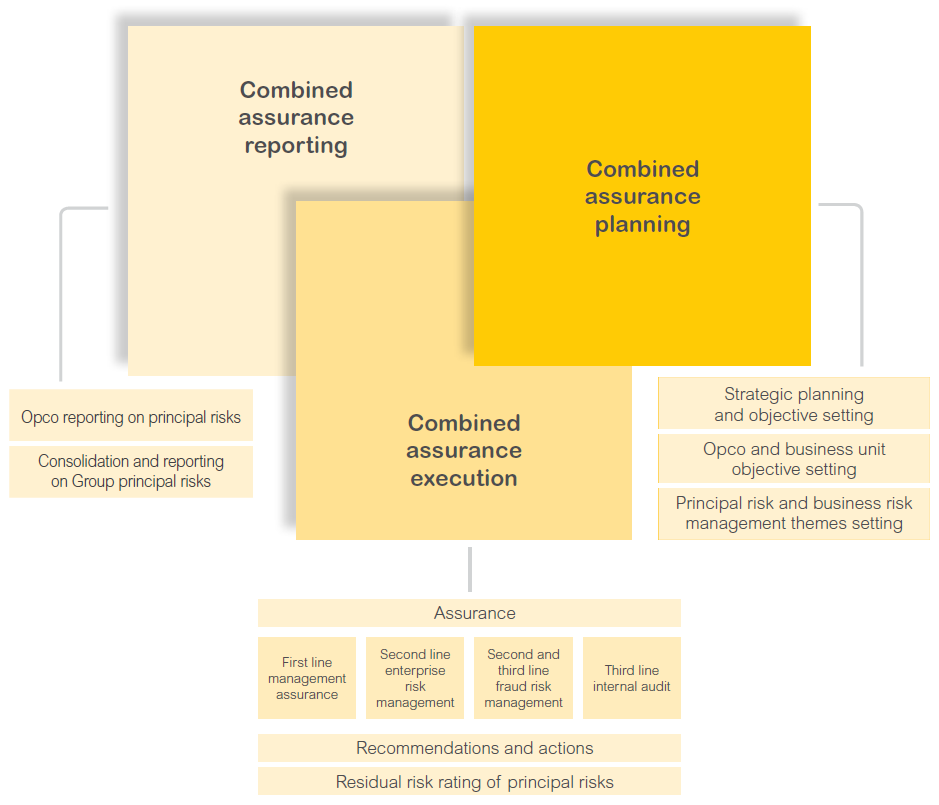
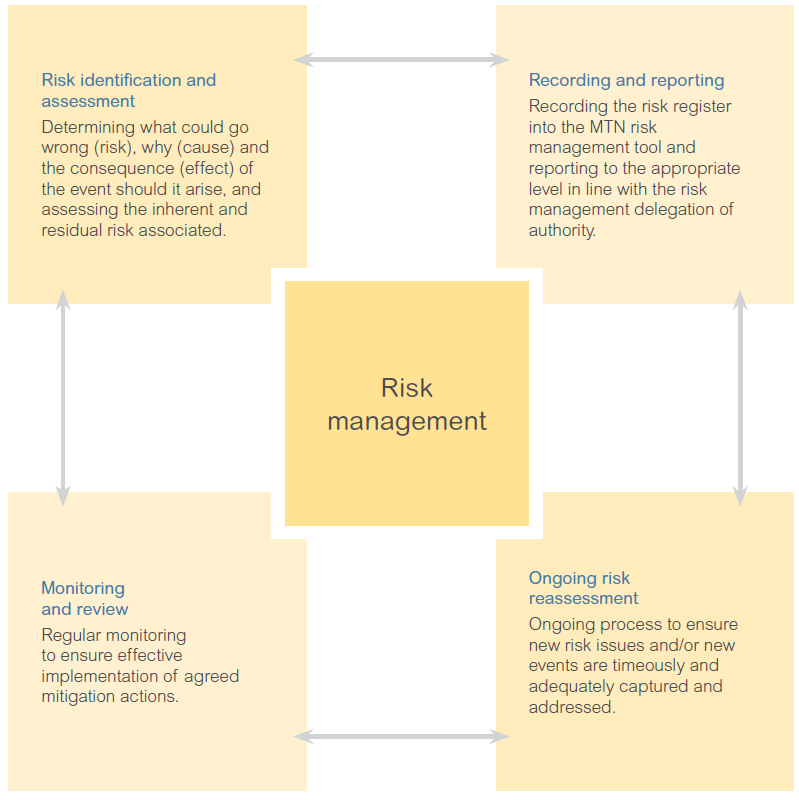
Our risk management processThe careful management of risk is critical for the MTN Group to achieve its strategy, which is driven through board-approved strategic priorities, which are constantly monitored. The MTN board understands and takes accountability for all risks and delegates the responsibility for overseeing the effectiveness of risk management to the board’s audit committee, the risk management, compliance and corporate governance committee, the remuneration and human resources committee as well as the social and ethics committee. We use a combined assurance methodology, details of which are set out below. For details of our top risks,
(
Aligning risk management and corporate governanceMTN’s risk management frameworks guide the operation of our business units, which are primarily responsible for risk management. In recent years, the Group has faced challenges implementing the risk management framework consistently across all operations. In 2015, we commissioned an independent assessment of the quality of work performed by BRM, to benchmark the BRM function in relation to world-class best practice, to assess the maturity of the BRM function and to design a future state together with a roadmap for transforming the BRM function. The assessment indicated the overall maturity level of the function to be “evolving”. Subsequently, management implemented a three-year plan to improve the maturity level to “established”. For MTN, an “established” level means that pertinent risks and material issues are effectively managed to meet stakeholder expectations to both protect and enhance value. We set up working groups to drive the implementation of the roadmap. These focus on:
Critical success factors will include, among others:
Business continuity management (BCM) and crisis risk management (CRM)Some of the major events which occurred in the past year highlighted gaps in our Group-wide BCM programme. To ensure that these gaps are addressed, we initiated a Group-wide BCM project to revamp and streamline our BCM approach and ensure that the Group has an effective structure to respond to disruptions in our business. Our BCM approach leverages on industry best practice and standards, including ISO 22301 standards for BCM and the Business Continuity Institute Good Practice Guidelines, and ensures that we put in place adequate measures to protect our business brand and reputation and comply with statutory, regulatory and contractual obligations. We enhanced and supported our BCM programme by introducing a Group-wide crisis management programme, which aims to improve our capability to respond to and manage crisis events across the MTN Group. Insurance and risk transferThe MTN insurance programme is built around the close connection between risk management and insurance using an annual assessment of risk management at each operating company. To achieve this, there is a strong commitment to the risk management assessment process, improving operational management’s adoption of risk management best practices and to reduce risks across the entire insurance programme. MTN has an insurance programme in place that covers perils such as physical/material damage, business interruption, political risk, public liability, directors’ and officers’ liability, crime and professional indemnity. The limits of indemnity for these covers have been structured so that MTN has adequate cover for its risks, but also gets maximum value from the programme and that premium spend is efficient. We also believe that risk retention and self-insurance are necessary to keep premiums at reasonable levels and show commitment towards risk management. MTN’s retention levels differ from policy to policy, guided by the nature of the risk being transferred. MTN has a cell captive structure in place to support the insurance programme. In 2015, we continued to build the captive’s capacity for additional risks which may best reside within it. This includes financial lines (fidelity guarantee, professional indemnity, and directors’ and officers’ liability) cover for Iran, Sudan and Syria which are uninsurable due to sanction constraints and/or political violence. We have no political violence cover in place for Syria and Sudan and no political risk cover in place for Syria, Sudan or South Sudan. Other operations that are not covered under this placement are South Africa, Botswana, Cyprus and Swaziland, as risk is perceived as low in these countries. Afghanistan is covered under a Multilateral Investment Guarantee Agency placement and Iran is covered under an Export Credit Insurance Guarantee Agency. Information and technology governanceMTN acknowledges information and technology as integral strategic assets to the business in delivering a bold new Digital World to its customers. MTN’s commitment to sound governance is supported by the ongoing activities and efforts in embedding the King III Code of Corporate Governance principles and recommendations, with specific focus on technology governance through the establishment of various responsibilities, processes and supporting governance structures. The Group information security function monitors the rollout of the security framework as per the deployment plan. Compliance to the framework will be independently assessed. Further, a new cyber strategy is being developed to ensure threats and vulnerabilities are proactively managed. Adequate effort at all levels and proper risk management practices will continue to ensure that technology governance is fully integrated across all MTN operations and that current and emerging information security risks, such as cyber security and data privacy, are proactively addressed. Fraud risk managementMTN Group’s fraud risk management strategy continues to evolve to meet the dynamic shifts in international fraud risk trends. Historically, MTN has been focused on fraud detection and response, however greater emphasis is now being placed on proactive fraud prevention strategies. The significant components of MTN’s fraud prevention strategy are the effective integration of fraud risk management within a combined assurance environment, the rollout of the MTN Group ethics framework and greater organisational fraud awareness. Thirteen MTN operations have dedicated forensic personnel. The rest of the operations are supported through the local internal audit and enterprise risk management functions or the Group fraud risk management function. The majority of identified fraud incidents are reported via internal channels with employees preferring to report potential fraud incidents directly to the investigation team. However, MTN continues to provide employees and relevant stakeholders with access to an anonymous reporting facility managed by Deloitte. All whistle-blowing reports received are investigated and feedback is provided to the Group’s audit and risk committee structures to ensure that independent governance is maintained. The MTN Group’s current top fraud risks are:
Internal auditThe MTN Group and all its subsidiaries embrace the principles of King III and recognise the significant opportunities that present themselves to companies that do so. Internal audit’s role is that of an objective and independent value-adding assurance provider that embraces a risk-based auditing approach, in line with King III, to the Group’s exco and board. It considers the risks that may hamper the achievement of strategic priorities and further determines the effectiveness of MTN’s systems of internal control and risk management. MTN’s internal audit has adopted a combined assurance model as a co-ordinated approach to all assurance activities. MTN has dedicated teams that perform internal audits across the Group. The internal audit function is being transformed in line with the recommendations of the evaluation that was undertaken during the year. At a Group level, internal audit reports functionally to the audit committee and administratively to the Group president and CEO. Internal audit coverage is extended to all operations and high-risk processes in line with the internal audit methodology. In 2015, more than 201 370 hours were spent on internal audit. |
 51