Risk management is integral to our operations, enabling agility, adaptability, and alignment with our strategic priorities.
MTN integrates risk management across all levels of the Group, ensuring proactive identification, assessment and mitigation of risks and opportunities that can potentially impact our business. We cultivate a risk-aware culture, leveraging a combination of top-down governance, bottom-up risk identification, and continuous horizon-scanning for emerging risks.
Our structured approach prioritises risks based on their likelihood,
impact and the effectiveness of existing controls.
This ensures focus
on the most material threats while enabling a swift response to
evolving challenges.
The MTN Board and its committees provide rigorous oversight of our risk framework, working closely with management to ensure its effectiveness. At the Opco level, risk management is reinforced through executive committees and audit and risk committees, ensuring alignment with local market dynamics while maintaining a cohesive Group-wide strategy.

Top-down approach
Identifies strategic-level risks and cascades these downwards Enables top management to make better risk-based decisions
Bottom-up approach
Identifies risks at a process, functional operational level Drives robust risk management across the enterprise
Emerging risk scanning
Supports our proactive strategy focused on continuously identifying and assessing new risks before they fully materialise, helping MTN to stay ahead of potential threats and adapt accordingly.
Maintaining a stable risk profile across MTN Group through comprehensive and sound risk management
A structured principal risk universe is central to our ERM approach. It establishes a consistent, two-tiered risk categorisation framework, ensuring comprehensive risk mapping across all Opcos. Bottom-up integration fosters alignment and uniformity, while a top-down view ensures completeness in risk identification. As our business evolves, the risk universe is continuously refined to reflect shifts in strategy, structure, and operations.
Our ERM framework translates risk appetite into actionable risk preferences for each principal risk. By defining clear thresholds and KRIs, we align risk-taking with business objectives, ensuring mitigation efforts and resource allocation are targeted and effective.
Risk appetite and tolerance thresholds are embedded within business planning and decision making, enabling us to navigate an increasingly complex landscape with clarity and control. This structured approach ensures that risk exposure remains within defined preferences while driving strategic execution in a dynamic operating environment.
We continue to strengthen our compliance framework, ensuring alignment with evolving regulatory landscapes and business imperatives. Our risk-based compliance approach prioritises proactive monitoring, testing and enhancement of internal controls to maintain a robust and agile compliance environment across the Group.
Key advancements include the implementation of control improvement initiatives,
enhancing governance structures and embedding compliance maturity. Through our
Project Guardian, we have reinforced data privacy and protection protocols, integrating
stringent safeguards into our operations.
Our business partner and trade compliance
processes have also been enhanced, ensuring greater due diligence, adherence to
sanctions regulations and responsible partner management.
Additionally, we have refined our compliance methodologies, strengthened monitoring tools and aligned compliance metrics with Group risk management frameworks.
We have strengthened our approach to stress and shock scenario analysis, ensuring greater adaptability to emerging risks. Our framework integrates stress testing, reverse stress testing, and catastrophic scenario analysis to assess the potential impact of extreme events on MTN's financial and operational stability.
Stress testing is applied across budgeting, liquidity management, and capital planning at both the Opco and Group levels. We assess various scenarios – including currency devaluation, inflationary pressures, regulatory shifts and funding constraints – to refine risk mitigation strategies.
Reverse stress testing helps identify conditions that could lead to severe financial strain, cash flow pressures, or operational disruptions, ensuring proactive risk responses. Additionally, catastrophic scenario analysis considers high-impact risks such as major cyber-attacks, network infrastructure failures, shifts in market dynamics and geopolitical disruptions to inform crisis preparedness and resilience planning.
By embedding these methodologies, we enhance decision making, improve financial and operational resilience, and ensure MTN remains well-positioned to navigate an evolving risk landscape.
MTN employs a combined assurance approach to enhance the effectiveness of risk
management, governance and control oversight. By integrating assurance efforts across
internal and external providers, we ensure comprehensive coverage of key risks while
validating that controls are in place and operating within defined risk thresholds. This
approach strengthens accountability,
co-ordination and risk mitigation across the Group.
We continue to strengthen our business resilience, ensuring operational continuity in a dynamic risk environment. Our ISO 22301 certification remains a key benchmark, supported by crisis simulations, enhanced continuity planning and structured resilience assessments.
Key improvements include refined response strategies, expanded risk horizon-scanning and strengthened data protection. Investments in alternative energy solutions and infrastructure redundancy help mitigate disruptions, while enhanced scenario planning and early threat detection ensure proactive risk management. By embedding resilience into our operations, we enhance our agility, continuity and long-term sustainability.


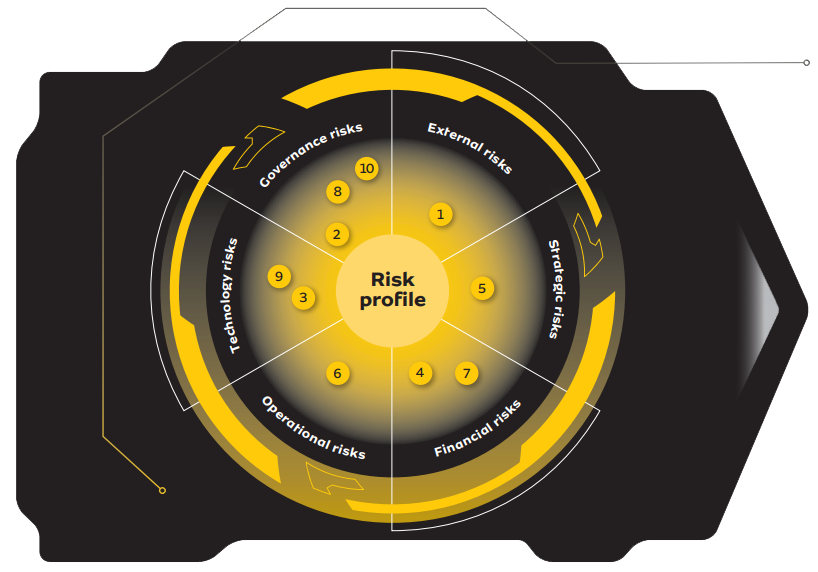
Our top ranked risks in 2024
1
2
5
4
3
New
7
8
9
New