
| Currently viewing: Chairman’s statement / Next: Group board of directors |
 |
 |
 |
Downloads |  |
Home |
Chairman’s statement
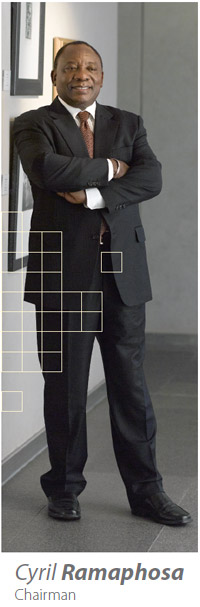
“The board is able to balance its growth aspirations with that of ensuring improved short-term returns to shareholders.”
Integrating our reporting
This year, MTN has started on a journey to provide a more integrated report, in terms of its social, environmental, economic and financial impacts and influences. This is one of the recommendations of the revised King Code and Report on Governance for South Africa (King III), which was published in 2010. The Group has worked towards ensuring compliance with King III’s many other guidelines as well as additional regulatory requirements in line with international best practice.
Increasing returns to shareholders
The activities of MTN have for many years been guided by its vision to be a leader in telecommunications in emerging markets, supported by the following key strategic pillars:
- participating in the consolidation of the emerging markets’ telecoms sector and reducing the concentration of MTN’s earnings;
- leveraging MTN’s existing footprint and intellectual capacity; and
- pursuing convergence and operational excellence.
MTN has delivered on this strategy through the various organic and acquisitive opportunities it has invested in to date.
In line with its ongoing pursuit of value-accretive opportunities, during the first half of 2010 MTN entered into discussions with an African and Middle Eastern telecoms operator relating to the acquisition of certain of that operator’s businesses. However, the discussions were terminated on 9 June 2010 and on 15 July 2010, the board of MTN announced a shift in the priority of its strategic pillars. Although the board will continue to evaluate value-accretive opportunities, it has recognised that limited transformational opportunities exist within emerging markets. The board anticipates that the Group will generate increased cash flow through lower capital expenditure and relatively stable EBITDA margins in the period ahead. As a consequence, the board is able to balance its growth aspirations with that of ensuring improved short-term returns to shareholders.
On 20 August 2010, MTN announced its maiden interim dividend, together with an increased dividend payout ratio of 40%. A further increase in the dividend payout ratio to 55% of the full-year adjusted earnings per share was advised on 9 March 2011 when the Group announced its full-year results.
Confronting challenges
MTN’s 2010 results were achieved under challenging conditions: competition intensified, regulators continue to be more demanding, the global economy’s recovery from recession was sluggish and the rand remained strong. But many emerging markets and economies – indeed, many of the markets in which MTN operates – proved to be relatively resilient.
Africa is considered by some as the last frontier of growth: its resource-dependent economies are slowly diversifying and more of its people are moving into the cities. MTN considers there to be considerable opportunity for greater mobile penetration and other value-added services in this region, one in which MTN feels comfortable doing business, helped by its experience of the past 16 years. MTN’s participation in the first FIFA World Cup™ on African soil proved this.
However, the current political upheaval in North and West Africa and the Middle East shows that operating in emerging markets requires long-term commitment and a steady hand as risks – be they political, economic, financial, social or regulatory – can, at times, appear overwhelming.
MTN adheres to a strong code of conduct and monitors country risks continuously, leveraging its dedicated risk management and stakeholder relationship function. It is constantly seeking to improve its medical, security and crisis risk management initiatives.
Engaging with regulators, developing new revenue streams and facing competition
Many countries consider the telecommunications industry to be one of strategic national importance. This, perhaps, has been one reason for increasing regulation across MTN’s footprint. In 2010, regulators in South Africa and Nigeria reduced mobile termination rates. The registration of each customer’s personal details was also implemented in these two important markets, as well as in several other countries.
MTN undertakes constructive and transparent engagement with regulators and has set up dedicated regulatory teams in each market to foster better communication.
Mobile licences continue to be issued in many markets, increasing competition. There are some operators whose business models appear to focus primarily on short-term tariff reduction. However, recent evidence suggests the preference of some regulators for a floor on tariffs. This is aimed at ensuring the sustainability and long-term commercial success of the sector. In turn, it is based on a growing acceptance of the important role of sound, reliable telecommunications businesses, and not forgetting the considerable taxes paid by these companies.
In recent years there has been an increase in the importance and focus on data and related products and services although these are still very much in their infancy in many of the markets in which MTN operates.
Various efficiency initiatives, including the conclusion of an infrastructure sale and lease back agreement in Ghana, address the mitigation of risks associated with the evolution of the industry and are dealt with in the operational sections of this report.
Focusing on the environment
MTN Group made considerable progress in integrating environmental matters into its core operations in 2010.
This is an important advance: many of the markets in which the Group operates are among the most vulnerable to climate change.
MTN is defined as a medium-impact company, and in 2010 worked to foster more responsible practices and efforts to preserve the environment and help mitigate the effects of global warming. MTN has investigated low-carbon and renewable sources of energy to power its base transceiver sites in a number of operations and is already reaping the rewards through lower operating costs, emissions and regulatory risk.
While many players in the information and communications technology sector are putting together programmes to step up the industry’s energy efficiencies, the sector’s biggest influence will be through playing an enabling role in fostering energy efficiency in other sectors. MTN’s leverage of this includes machine-to-machine solutions, teleconferencing and telepresence and a recent energy efficient data centre which improves the cost base for corporate customers.
MTN’s environmental efforts are detailed in the carbon footprint report on the JSE’s Socially Responsible Investment Index and in the Group’s sustainability report available on www.mtn.com/ sustainability.
Working with communities
In 2010, MTN continued to work with communities mainly through MTN Foundations which facilitate and fund various initiatives and partnerships aimed at stimulating and contributing to both economic and social development.
By its very nature, MTN’s offering is a key element of countries’ infrastructure and an enabler of development. The Group works to enhance wider access to mobile services, promoting inclusivity. It strives to build its network responsibly, by ensuring safety for people and the environment and securing customer privacy.
One of the highlights of 2010 was the finalisation of MTN Zakhele – the largest black economic empowerment equity ownership deal in the South African telecoms sector. The result is an initiative that not only demonstrates MTN’s commitment to the codes of black economic empowerment in South Africa but more importantly contributes to the sustainable economic and social development of previously disadvantaged people.
Appreciating outstanding leadership
The year under review was the last full year that Phuthuma Nhleko held the position of Group president and chief executive officer following his resignation, effective 1 April 2011. The board and I would like to congratulate and thank Phuthuma for his enormous contribution to the success of MTN since his appointment to the position in July 2002.
Phuthuma is a visionary leader who is focused and hard working. He has an incisive ability to build good management teams and take calculated risks: he has taken MTN where many feared to go – and shown resilience in the face of setbacks.
However, stakeholders can feel confident that Phuthuma has left the Group’s affairs in good hands – those of Sifiso Dabengwa, Group chief operating officer in the year under review. In Sifiso’s 12 years with MTN, he has run the operations of South Africa and Nigeria, before taking on the Group COO role.
It has been announced that MTN is investigating the establishment of MTN International (MTNI). A subcommittee of the board has been established to thoroughly investigate the implications and rationale for the structure. Should a formalised subsidiary board structure for MTNI be approved, it is envisaged that Phuthuma Nhleko will accept an invitation to become non-executive chairman of the MTNI board of directors. An announcement on the final outcome of these investigations will be made as soon as they are completed. Phuthuma has separately accepted an invitation to rejoin the MTN Group board as non-executive vice-chairman with effect from 1 October 2011.
Three new independent, non-executive directors joined the board on 1 January 2010: Peter Mageza, Alan Harper and Dawn Marole.
Doug Band, an independent non-executive director of the Group, who also served as chairman of the nominations, remuneration, human resources and corporate governance committee, tendered his resignation from the board effective 11 March 2011. The directors and I wish to extend our appreciation to Doug for his outstanding contribution since he joined the board in October 2001.
Alan van Biljon, an independent non-executive director of MTN and the audit committee chairman, has been appointed as lead independent director effective 14 March 2011. The position of lead independent director is new at MTN and was created to further embed the culture of independence of the board of directors especially in instances of perceived conflict of interest.
 Alan Harper, an independent non-executive
director and member of
the nominations, remuneration,
human resources and corporate
governance committee of
MTN since 1 January 2010, has
been appointed chairman of that
committee on 14 March 2011. He
succeeds Doug Band.
Alan Harper, an independent non-executive
director and member of
the nominations, remuneration,
human resources and corporate
governance committee of
MTN since 1 January 2010, has
been appointed chairman of that
committee on 14 March 2011. He
succeeds Doug Band.
The board and I would like to congratulate both Alan van Biljon and Alan Harper on their new roles.
Looking forward
With a strong focus on cost management as well as on securing new revenue streams, MTN is well positioned in its markets to compete within a changing competitive and regulatory landscape.
The Group’s attempt to make this year’s report a more integrated one is the beginning of a process towards achieving a better articulation of MTN’s strategy, risks and opportunities and we trust it will help stakeholders to better assess the ability of MTN to create and sustain value.
Cyril Ramaphosa
Chairman
March 2011
|