The impact of these two pronouncements on the annual financial statements has not yet been fully determined.
The Group’s preliminary unaudited assessment of the key requirements is set out below:
| |
Key requirements |
|
|
Impact |
| |
Bundled offerings
IFRS 15 requires entities to allocate revenue
to performance obligations based on the
standalone selling price of a good or service in
a bundle of goods and services. A performance
obligation is a promise in a contract to transfer
a distinct good or service to a customer.
Revenue is recognised when a customer obtains
control of a good or service. A customer obtains
control when it has the ability to direct the use of
and obtain the benefits from the good or service. |
|
|
Postpaid and prepaid products with multiple deliverables are
defined as multiple element (or bundled) arrangements.
Postpaid products typically include the sale of a handset and
a service contract; and prepaid products include a subscriber
identification module (SIM) card and airtime.
During 2014, the Group resolved to change its accounting
policy in recognising revenue relating to bundled arrangements
from applying the residual value method to the relative fair
value method. In applying the relative fair value method, the
consideration received or receivable is allocated to each of the
elements (delivered and undelivered) in the transaction
according to their standalone selling prices, resulting in the
proportionate allocation of any discount to all elements in the
bundle.
The new accounting policy aligns the Group’s policy more
closely with the requirements of IFRS 15. |
|
|
|
|
|
| |
Contract changes
IFRS 15 requires entities to account for contract
modifications as cancellations of the old
contracts and the creation of new contracts
where additional distinct goods or services are
provided at prices that do not reflect the
standalone selling prices of those goods or
services. |
|
|
Postpaid contracts may be upgraded or downgraded by
customers which will typically result in the cancellation of the
old contract and the creation of a new contract. Contract
changes are significant in MTN South Africa and to a lesser
extent, in MTN Cyprus.
This requirement has been implemented as part of the Group’s
policy change in recognising revenue relating to bundled
arrangements as discussed above. |
|
|
|
|
|
| |
Significant financing component
IFRS 15 requires entities to adjust the promised
amount of consideration to reflect the time value
of money if the contract has a significant
financing component.
Factors to consider when determining whether a
contract has a significant financing component
include, but are not limited to:
 |
the expected length of time between when
the entity transfers the promised goods or
services to the customer and when the
customer pays for those goods or services; |
|
whether the amount of consideration would
differ substantially if the customer paid in cash
promptly in accordance with typical credit
terms in the industry and jurisdiction; and |
|
the interest rate in the contract and prevailing
interest rates in the relevant market. |
|
|
|
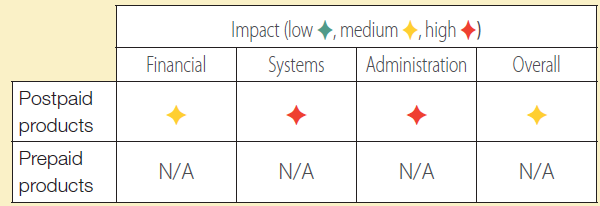
N/A – not applicable.
This requirement is expected to have a significant impact on
the Group’s postpaid subscriber base where devices are sold
with long-term service contracts mainly within MTN South
Africa and to a lesser extent, in MTN Cyprus.
If possible, the Group will elect the practical expedient to not
adjust the promised amount of consideration for the effects of
a significant financing component if its expected, at contract
inception, that the period between when the entity transfers
a promised good or service to a customer and when the
customer pays for that good or service will be one year or less. |
|
|
|
|
|
| |
Contract acquisition costs
IFRS 15 requires an entity to recognise as an asset
the incremental costs of obtaining a contract
with a customer if the entity expects to recover
those costs.
The incremental costs of obtaining a contract
are those costs that an entity would not have
incurred if the contract had not been obtained.
All other contract acquisition costs incurred
regardless of whether a contract was obtained
are recognised as an expense.
Contract costs recognised as an asset are
amortised on a systematic basis consistent with
the pattern of transfer of the goods or services to
which the asset relates. In some cases, the asset
might relate to goods or services to be provided
in future anticipated contracts (for example,
service to be provided to a customer in the future
if the customer chooses to renew an existing
contract). |
|
|
The Group’s current accounting policy is to expense contract
acquisition costs when incurred.
The Group will elect the practical expedient permitted by IFRS
15 to expense incremental costs of obtaining a contract when
incurred if the amortisation period would be one year or less.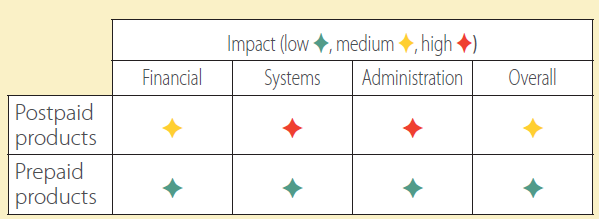
This requirement is expected to have a significant impact on
long-term postpaid contracts, mainly within MTN South Africa
and to a lesser extent, in MTN Cyprus. Significant system
development will be required to identify, track and amortise
contract acquisition costs over the contract period or estimated
customer life.
No significant impact is expected within the Group’s prepaid
environment as the prepaid service lifecycle is typically short. |
|
|
|
|
|
| |
Breakage
IFRS 15 requires that when a breakage
percentage (services that expire) is expected,
revenue should be grossed up to take account
of units of service that will be forfeited. |
|
|
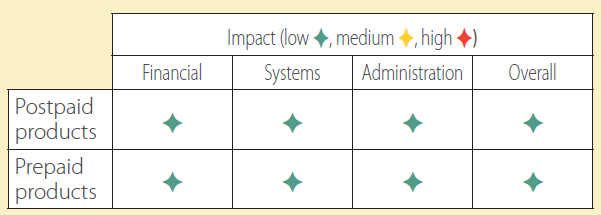
This requirement is not expected to result in a significant
change in the financial results of the Group. |
|
|
|
|
|
| |
Loyalty awards
IFRS 15 requires that loyalty awards be recognised
as separate performance obligations and that
revenue be allocated to awards relative to the
fair value of the awards and other performance
obligations. Revenue allocated to the loyalty
awards should be recognised when the future
goods or services are transferred or when the
awards expire. |
|
|
The Group’s current accounting policy is to recognise reward
points as separately identifiable components of the initial sale
transaction by allocating revenue to the reward points such
that the reward points are initially recognised as deferred
income at their fair value.
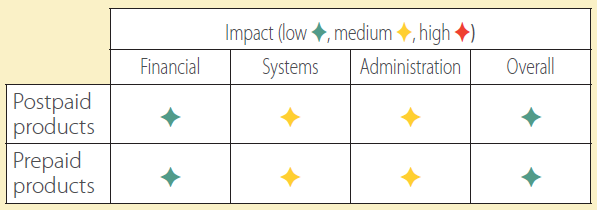
This requirement is not expected to result in a significant
change in the financial results of the Group. |
|
|
|
|
|
| |
Impairment
IFRS 9 requires that credit losses are recognised
on initial recognition of receivables and contract
assets and not at the point when the amounts
are considered to be impaired. |
|
|
Provision for impairment of receivables and contract assets will
be upfront and recognised separately when the revenue is
recognised, modelled on historic losses.
The Group expects to choose an accounting policy to always
measure the impairment at the present value of expected cash
shortfalls over the remaining life of the receivables and contract
assets using a provision matrix.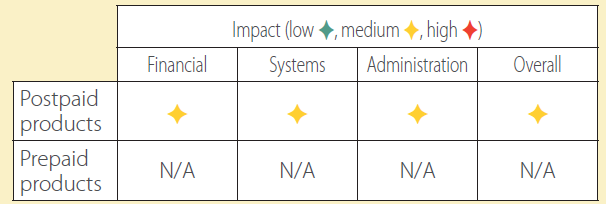
N/A – not applicable.
This requirement is expected to have a significant impact on
long-term postpaid contract assets and receivables, mainly
within MTN South Africa. |
